
The EOR Model for Singapore Businesses: 2026 Guide


The EOR model, formally known as the Employer of Record model, is defined as a legal arrangement where a third-party provider assumes the role of official employer for workers in a foreign country on behalf of a client company. The EOR handles payroll, tax withholding, statutory benefits, and local labor law compliance. The client company retains full operational control over the employee’s day-to-day work. For Singapore businesses expanding into new markets, this structure removes the need to incorporate a foreign legal entity before making a single hire.
How does the EOR model simplify cross-border employment?
Speed is the most immediate advantage. Companies can deploy staff in 7–21 days through an EOR, compared to the months required to incorporate a foreign entity, obtain local licenses, and set up payroll infrastructure. That difference alone changes what is possible for a Singapore business testing a new market.
The EOR takes on the full administrative stack. It drafts locally compliant employment contracts, runs payroll in local currency, withholds income tax, and administers mandatory benefits such as social security contributions and statutory leave. The client company tells the employee what to do. The EOR makes sure the employment is legal.

Compliance risk is also transferred. Noncompliance with HR regulations can result in average legal fees and penalties of $34,000 USD per incident, plus productivity losses and reputational damage. An EOR absorbs that exposure by keeping its legal entities current with local labor law changes across every jurisdiction it covers.
Pro Tip: Before signing with any EOR provider, confirm whether they own their legal entities in your target countries. Providers that own local entities deliver faster onboarding and tighter compliance controls than aggregator-based models that subcontract to third parties.
The reduction in administrative overhead is real and measurable. Your HR team does not need to learn Malaysian EPF contribution rules or Indonesian BPJS requirements. That knowledge lives inside the EOR. Your team focuses on the work that actually grows the business.
What are the main advantages of the EOR model vs traditional hiring?
The core advantage of the EOR model over traditional entity-based hiring is cost efficiency at low headcount. Entity setup costs range from $10,000 to $50,000 or more in legal fees, registered capital, and government filings. An EOR requires only a monthly service fee per employee. For a Singapore firm hiring its first two or three people in Vietnam or Indonesia, the math strongly favors the EOR model.
Key EOR model advantages at a glance
Speed to market. Hire in weeks, not months, with no entity setup required.
Cost control. Pay a predictable per-employee fee rather than absorbing fixed entity overhead.
Compliance transfer. The EOR owns local labor law risk, not your legal team.
Flexible scaling. Add or reduce headcount without restructuring a legal entity.
Retention support. EOR-managed employees show an 85% retention rate at 12 months, reflecting the professional employment experience EORs provide.
Pro Tip: The EOR model works best for your first 1–20 hires in a new market. Use it to validate demand and build a local team before committing to entity incorporation.
HRIS integration is another advantage that often goes underappreciated. When your EOR connects to your existing HR platform, you get a single view of your entire workforce, including full-time employees in Singapore, contractors, and EOR-managed staff abroad. That visibility supports better workforce planning and reduces payroll errors caused by disconnected systems.
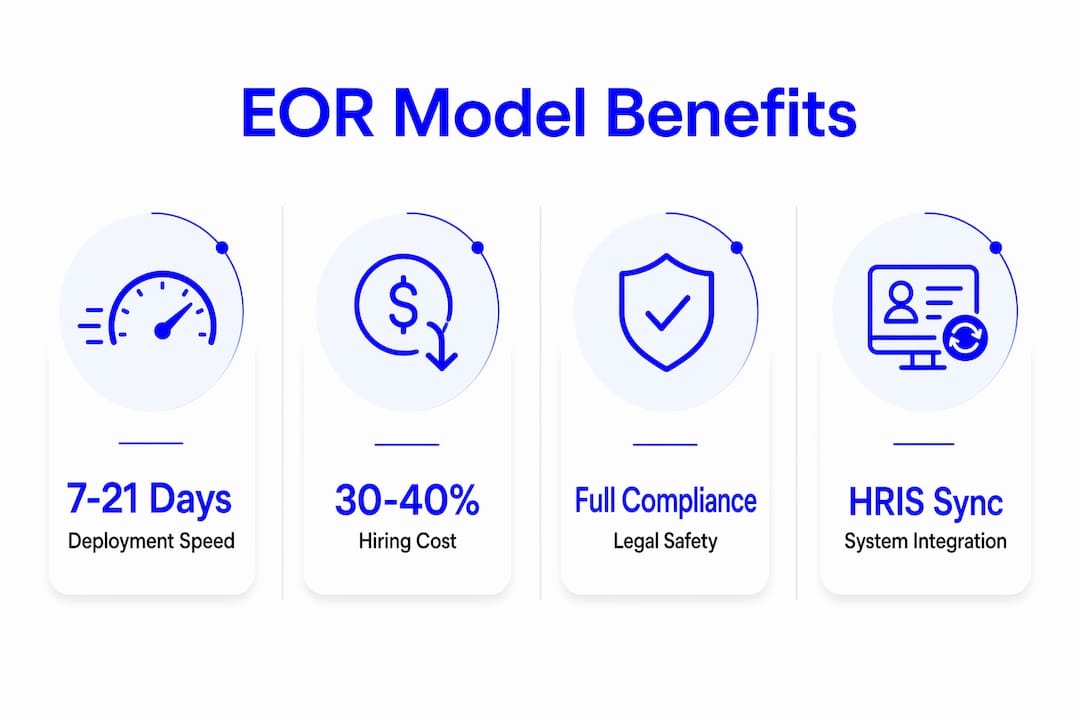
The EOR model also produces measurable hiring cost reductions. Businesses using EOR arrangements report 30–40% lower hiring costs compared to traditional entity-based employment. That figure reflects savings on legal fees, HR administration, and compliance management combined.
What cost factors should Singapore businesses expect with EOR services?
EOR pricing is straightforward. Standard monthly fees range from $300 to $700 per employee, depending on the regulatory complexity of the target country and the provider’s infrastructure. Countries with complex labor codes, mandatory benefits structures, or high statutory contribution rates sit at the upper end of that range.
What the monthly fee covers
Cost component | What it includes |
Payroll processing | Salary calculation, local currency disbursement, payslips |
Tax withholding | Income tax filing and remittance to local authorities |
Statutory benefits | Social security, health insurance, pension contributions |
Compliance management | Labor law monitoring, contract updates, regulatory filings |
HR support | Employee onboarding, offboarding, and ongoing HR queries |
Some providers charge separate onboarding or offboarding fees. Confirm this before signing. The monthly fee structure makes budgeting predictable, which matters when you are managing a cross-border team across multiple currencies.
The cost crossover point is the critical number to track. At 15–25 employees in a single market, the cumulative EOR fees often exceed the annualized cost of running a local entity. At that scale, incorporating locally and hiring a local HR manager typically becomes more cost effective. The EOR model is not a permanent structure for large teams. It is the right tool for market entry and early-stage growth.
Owned-entity EOR providers charge differently than aggregator models. Owned entity providers deliver stronger legal protections and tighter compliance controls, and their pricing reflects that infrastructure investment. Aggregators may appear cheaper upfront but introduce third-party risk that can create compliance gaps.
How does the EOR model integrate with existing HR systems?
HRIS integration is not a nice-to-have feature. 63% of mid-market companies list HRIS integration as a top priority when selecting an EOR provider. That figure reflects how much operational friction comes from managing global employees in disconnected systems.
A well-integrated EOR connects to platforms like Workday, BambooHR, or SAP SuccessFactors to push employee data, payroll records, and leave balances into a single dashboard. Your Singapore-based HR team sees every employee, regardless of country, in one place. That consolidation reduces manual data entry, cuts payroll errors, and gives leadership accurate headcount data for planning.
The benefits extend beyond administration. Consolidated workforce data lets you compare compensation across markets, identify retention risks early, and model the cost of scaling a team in a new country before committing. For Singapore businesses managing teams across Southeast Asia, that visibility is a genuine operational advantage.
Outsourcing payroll and compliance to an EOR also frees internal HR capacity for higher-value work, a pattern seen across professional services firms in multiple markets. The administrative burden of multi-country payroll is significant. Removing it from your team’s plate has a direct impact on what they can accomplish.
Key Takeaways
The EOR model is the most cost-efficient and legally sound way for Singapore businesses to hire internationally at headcounts below 20 employees per market.
Point | Details |
Deployment speed | EOR arrangements get employees working in 7–21 days, far faster than entity setup. |
Cost efficiency | Monthly fees of $300–$700 per employee replace $10,000–$50,000 in entity setup costs. |
Compliance transfer | The EOR absorbs local labor law risk, removing a $34,000 average penalty exposure from your business. |
Scale threshold | At 15–25 employees per market, a local entity typically becomes more cost effective than EOR fees. |
HRIS integration | 63% of mid-market firms prioritize EOR providers that connect to existing HR platforms for unified data. |
What I’ve learned about using the EOR model strategically
The EOR model gets sold as a cost-saving tool. That framing undersells it. The real value is operational headspace.
When I work with Singapore businesses expanding into new markets, the conversation usually starts with cost. How much does it cost to hire in Thailand? What are the payroll taxes in the Philippines? Those are valid questions. But the more important question is: what does your team stop doing when the EOR takes over? The answer is usually a significant amount of compliance management, contract drafting, and HR administration that was quietly consuming time your team could not afford to lose.
The operational burden reduction from offloading compliance and payroll to an EOR is often more valuable than the direct cost savings. A founder who is no longer reading Indonesian labor law updates at midnight is a founder who is building the business instead.
My honest advice on provider selection: always choose an EOR that owns its legal entities in your target markets. Aggregator models introduce a layer of third-party risk that is invisible until something goes wrong. When a compliance issue surfaces in a country where your EOR subcontracts to a local partner, you are two steps removed from the problem. That is not a position you want to be in.
The scale threshold matters too. The EOR model is the right answer for your first hires in a new market. It is not the right answer forever. When your headcount in a single country crosses 15–25 employees, run the numbers on local entity incorporation. The EOR has done its job by that point. It got you into the market fast, kept you compliant, and gave you time to decide whether the market is worth a permanent structure.
— Colin
Headington’s EOR employment solutions for Singapore businesses
Singapore businesses expanding internationally need more than a vendor. They need a partner who understands both the local regulatory environment and the target market’s labor law in equal depth.
Headington provides EOR employment solutions built for Singapore-based businesses pursuing cross-border growth. With 25 years of in-house expertise across 90 countries, Headington manages payroll, compliance, statutory benefits, and employment contracts so your team can focus on the work that matters. Whether you are hiring your first employee in Malaysia or building a regional team across five markets, Headington delivers compliant, fast, and transparent global hiring. Connect with Headington to get a clear picture of what international expansion looks like for your business.
FAQ
What is the EOR model?
The EOR model is a legal employment structure where a third-party Employer of Record hires workers on behalf of a client company in a foreign country. The EOR manages payroll, taxes, benefits, and compliance while the client company directs the employee’s work.
How fast can an EOR deploy employees?
Companies can deploy staff through an EOR in 7–21 days, compared to several months for traditional entity setup. This speed makes the EOR model the preferred choice for fast market entry.
When does it make sense to switch from EOR to a local entity?
The cost crossover point typically occurs at 15–25 employees in a single market. Beyond that headcount, the cumulative EOR fees often exceed the annualized cost of running a local legal entity.
What does EOR pricing typically include?
Standard EOR fees of $300–$700 per employee per month cover payroll processing, tax withholding, statutory benefits, compliance management, and HR support. Some providers add separate onboarding or offboarding fees, so confirm the full fee structure before signing.
Is the EOR model suitable for Singapore businesses hiring across Southeast Asia?
The EOR model is well suited for Singapore businesses hiring across Southeast Asia because it removes the need to incorporate legal entities in each country. It transfers local compliance risk to the EOR provider and allows flexible scaling across multiple markets from a single service agreement.


Comments