
Stop cash drain in 90 days for Singapore micro firms

Updated: 2 days ago

Rising costs, fragile cashflow, skills gaps and slow digital adoption are the four problems that decide whether a micro or small enterprise stabilises or stalls. The first task is arithmetic, not strategy: work out your cash runway in weeks, then decide whether you need short-term finance, better bookkeeping, or professional advisory support before anything else.
TL;DR:
Most micro firms face high costs in manpower, rent, and utilities, requiring regular pricing reviews and supplier negotiations to protect margins.
Access to finance is limited by credit crunch conditions, making cash runway calculations and receivables management essential before applying for funding.
Prioritizing cash flow and bookkeeping allows micro firms to build resilience, while staffing and technology pilots should follow based on immediate needs.
Digital tools like cloud accounting, e-invoicing, and AI assistants can deliver quick productivity gains through short-term pilots rather than full-scale rollouts.
Business support should focus on straightforward fixes, such as fixed-fee bookkeeping and compliance services, to free owner time and improve operational stability.
Table of Contents
3. Manpower, retention and upskilling: practical approaches for micro firms
4. Digital adoption and productivity technology: priorities and low-cost pilots
5. Rising operating costs and pricing pressure: actionable trade-offs
6. Regulatory and administrative burden: what to expect and when to outsource
7. Why micro firms are not just ‘smaller SMEs’ and what that means for actions
8. Action checklist: a prioritised 90 day plan for micro firms
9. Headington’s practical support model: what advisers deliver for micro clients
1. Top challenges micro and small enterprises face
Every micro firm experiences these pressures differently, but the pattern repeats across sectors. Before diving into any single issue, it helps to see the full map so you know where your own business sits.
Rising operating costs. Manpower, rent and utilities squeeze margins faster than most owners can reprice, and we unpack the specific trade-offs later in this article.
Cashflow fragility and access to finance. Credit pressure hits smaller firms harder than large ones, and the diagnostics in the next section show how to spot trouble early.
Manpower availability and retention. Hiring and keeping staff on a microbudget demands different tactics to those used by larger SMEs, covered in detail further down.
Digital adoption barriers. Many firms have adopted some digital tools but use them shallowly, a gap we translate into a short technology roadmap below.
Regulatory and administrative burden. Compliance tasks consume disproportionate owner time relative to firm size, with a checklist later in this piece.
Market competition and customer acquisition. Standing out against better-funded competitors requires sharper positioning rather than bigger budgets.
Supply chain and logistics exposure. Even service-based micro firms feel knock-on effects from supplier disruption and freight costs.
Cybersecurity and data protection gaps. Smaller firms are frequently under-protected relative to the data they actually hold.
Each of these interacts with the others. A firm with weak bookkeeping, for instance, struggles doubly when applying for financing, because lenders ask for clean records before they ask for collateral. Treating these as one connected system, rather than eight separate fires, is the difference between a 90-day recovery plan and a slow drift into insolvency.
2. Finance and cashflow: evidence and practical indicators
Financing pressure is not evenly distributed. Smaller firms face a higher incidence of credit pressure than large companies, with a notable share reporting moderate to severe credit crunch conditions as of Q2 2026, according to the SBF enterprise financing survey.
Statistic: A significant share of SMEs reported moderate to severe credit crunch conditions, higher than that of large companies. That gap matters because it confirms what most micro owners already sense: lenders treat smaller, thinner balance sheets as inherently riskier, regardless of how the business is actually performing.
The same survey found that businesses under financial pressure prefer one-to-one advisory and clinics with financiers over self-service tools, a preference that shapes how support should be delivered rather than just what support exists.
Common financing routes for micro firms include:
Enterprise Financing Scheme loans, often accessed via the SME Working Capital Loan, though applicants frequently cite high financing costs and eligibility hurdles.
Trade credit from suppliers, used informally to bridge short gaps without involving a bank.
Invoice financing or factoring, useful when receivables are the main drag on liquidity rather than the cost base itself.
Director or owner loans, common among micro firms but risky when personal and business finances are not kept separate.
Application friction is real. Lenders typically require detailed financial documents, personal guarantees from directors, and proof of recurring revenue, none of which a very young or very small firm can always produce cleanly. Approval timelines often span several weeks, which is often too slow for a firm already short on cash.
Two diagnostics help before you approach anyone for money. First, calculate cash runway: divide your current cash balance by your average monthly burn rate (fixed costs plus variable costs minus incoming receipts) to get the number of months you can survive without new revenue. Second, run a receivables ageing check: list every outstanding invoice by how many days it has been unpaid, and flag anything over 60 days as a collection priority rather than a rounding error. Firms that do both before applying for finance tend to present a clearer picture to lenders and often negotiate faster.
3. Manpower, retention and upskilling: practical approaches for micro firms
Manpower cost is the single most frequently cited cost pressure among businesses, with 63% of firms naming it as their top concern, well ahead of rental costs at 40%. For a micro firm with two or three staff, losing even one person means losing a meaningful share of total capacity, which makes retention as important as hiring.
Training is often the first budget line cut when money is tight, yet poorly trained staff cost more in errors and turnover than structured training ever would. Annual business survey materials identify a lack of suitable training and difficulty applying for schemes as persistent barriers for micro firms, as noted in SCCCI’s annual business survey and budget recommendations.
Practical moves that do not require a training budget:
Redesign roles around strengths rather than filling a generic job description, so staff spend more time on what they do well.
Offer flexible scheduling where possible, which costs nothing and is frequently cited by small employers as a retention lever.
Cross-train two people on every critical task, so a single absence does not stall the business.
Check for subsidy-backed training before paying full price for external courses, since schemes exist precisely to offset this cost.
Pro Tip: Build a 15-minute structured on-the-job micro-training session into each week, focused on one skill gap at a time, rather than waiting for a full course to become available.
This approach suits micro firms better than formal programmes because it fits around daily operations instead of requiring staff to step away entirely.
4. Digital adoption and productivity technology: priorities and low-cost pilots
Digital adoption among smaller firms has widened substantially, but intensity of use often remains shallow. According to the IMDA SG digital economy report, 95.1% of SMEs had adopted at least one digital area in 2024, while AI adoption among SMEs rose from 4.2% in 2023 to 14.5% in 2024. That is a meaningful jump in a single year, though it still means most smaller firms have not yet brought AI tools into daily operations.
For a micro firm, the priority is not the newest tool, but the one that removes the most manual work right now:
Cloud bookkeeping software to replace spreadsheets and reduce reconciliation errors.
E-invoicing to speed up payment cycles and reduce the receivables ageing problem described earlier.
A lightweight CRM to track customer interactions without the overhead of enterprise software.
Sector-specific solutions under the Productivity Solutions Grant, which can offset the upfront cost of qualifying tools.
Off-the-shelf AI assistants for routine admin tasks such as drafting correspondence or summarising documents, which require no technical setup.
Rather than committing to a full rollout, run a 30 to 60 day pilot: pick one tool, define a single measurable objective (hours saved per week, invoices processed faster, fewer data entry errors), and track it against a baseline from the month before. This reduces the uncertainty around return on investment that often stalls technology decisions in smaller firms, where every dollar spent needs a clear justification.
5. Rising operating costs and pricing pressure: actionable trade-offs
Cost pressure erodes margin quietly, and manpower and rental costs sit at the top of the list for most firms, cited by 63% and 40% of businesses respectively in SBF’s national business survey. Utilities compound this further, particularly for firms with physical premises or equipment-heavy operations.
Tactical responses that protect margin without alienating customers:
Review pricing annually at minimum, since static prices against rising costs is a slow method of losing money.
Negotiate supplier terms proactively, especially payment timing, rather than waiting until cash is tight to ask.
Track inventory turns if you hold stock, since slow-moving stock ties up cash that could cover payroll or rent.
Bundle services rather than discount them, which protects headline pricing while still offering perceived extra value.
Cost-cutting becomes counterproductive when it touches the things customers actually value, such as response times or product quality. Cutting training, as noted earlier, tends to cost more in errors than it saves in fees. The safer targets are usually administrative overhead, underused subscriptions and supplier terms, not the staff or quality that keep customers returning.
6. Regulatory and administrative burden: what to expect and when to outsource
Policy analysis of micro and small firms points to a structural problem: compliance obligations are frequently designed with larger SMEs in mind, then applied uniformly, which creates disproportionate friction for the smallest operators. Research on SME development policy and challenges notes that policy bundling of this kind can overlook how differently micro firms actually operate day to day.
A short compliance checklist worth running quarterly:
Confirm statutory filing deadlines for annual returns and tax submissions well ahead of time.
Check scheme eligibility before assuming you qualify, since criteria change and vary by sector.
Keep director and shareholder records current, since outdated registers cause delays at the worst possible moments.
Review data protection obligations alongside other compliance tasks rather than as an afterthought.
Outsourcing becomes worth considering once administrative tasks consistently cost more owner hours than the fee would cost in cash. A rough threshold: if compliance and filing work takes more than four or five hours a month away from revenue-generating activity, a fixed-fee service often pays for itself. For scheme eligibility checks, the Enterprise Singapore Enterprise Financing Scheme and Productivity Solutions Grant pages are the most direct starting points.

7. Why micro firms are not just ‘smaller SMEs’ and what that means for actions
Treating a micro firm as a miniature version of a mid-sized SME misreads the problem. Policy and research materials highlight that micro businesses are often folded into broader SME policy without separate consideration, which overlooks genuine behavioural differences, as argued in the ERIA paper on SME development in Singapore.
In practice, micro firms tend to be owner-led with decisions made by one person rather than a management team, often mix personal and business finances in ways that distort the real financial picture, and participate far less in trade associations or formal networks where support and information usually circulate. Data quality on micro firms is also weaker generally, since many transactions and decisions never get recorded in a form that a survey or a lender can easily use.
The practical implication is that micro owners should prioritise a small number of simple, trackable figures rather than an elaborate dashboard: cash runway in weeks, gross margin by product or service line, and customer concentration (what share of revenue comes from your single largest client). These three numbers surface most emerging problems early enough to act on them.
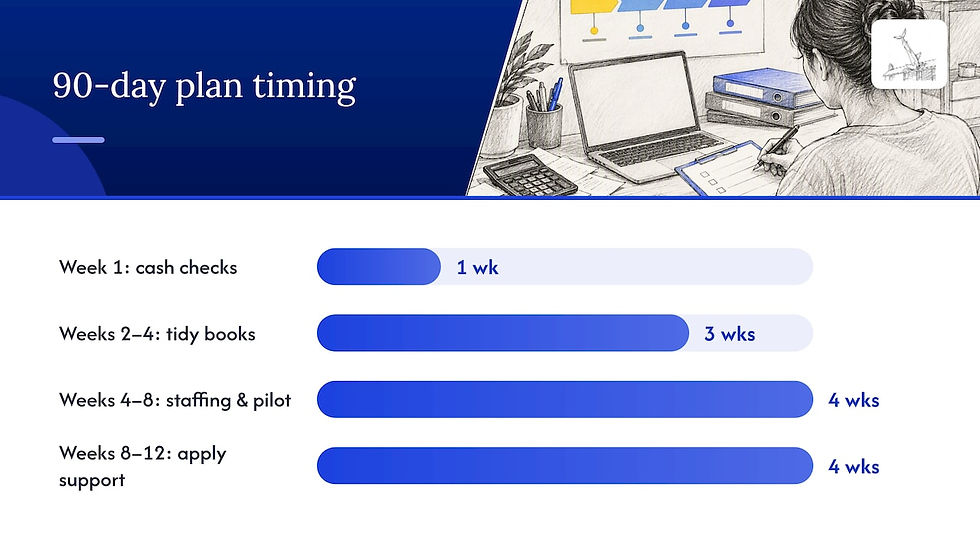
8. Action checklist: a prioritised 90 day plan for micro firms
Stabilising a micro firm works best as a sequence, not a simultaneous push on everything at once.
Week 1: calculate cash runway and receivables ageing. These two numbers determine whether your next move is financing, collections, or neither.
Weeks 2 to 4: tighten bookkeeping and essential costs. Clean records make every later step, from financing applications to tax filing, faster and cheaper.
Weeks 4 to 8: address the most urgent staffing gap. Decide whether the fix is role redesign, flexible scheduling, or a subsidised training scheme.
Weeks 4 to 8: run one 30 to 60 day technology pilot. Pick the single tool that removes the most manual work, as outlined earlier, and measure it properly.
Weeks 8 to 12: apply for relevant government support. Check eligibility before applying, and prepare the documentation lenders and schemes typically request in advance.
By week 12: review whether paid advisory is justified. If compliance, bookkeeping or financing applications are consuming more owner time than they are worth, that is the signal to bring in outside help.
Pro Tip: When you do engage a paid adviser, ask for a fixed deliverable list, a clear fee structure, and a realistic timeline upfront, rather than an open-ended hourly arrangement.
This sequence works because it resolves the most dangerous risk (running out of cash) before tackling the most time-consuming one (technology adoption), and leaves the decision about professional advisory until you have enough information to brief one properly.
9. Headington’s practical support model: what advisers deliver for micro clients
Our work with smaller firms tends to start exactly where this checklist ends: bookkeeping that is behind, compliance that has drifted, or an entity structure that no longer fits how the business actually operates. We offer fixed-fee starter packages alongside corporate secretarial, bookkeeping and entity establishment services, built so a micro firm can outsource a specific pain point rather than commit to a full retainer from day one.
Clients typically gain back owner hours previously spent on filing and reconciliation, a clearer view of cash runway once records are current, and compliance that no longer depends on remembering deadlines manually.
10. Market competition and customer acquisition challenges
Smaller firms rarely lose to competitors on product quality. They lose on visibility, because larger rivals can outspend them on marketing and absorb a longer customer acquisition cost before turning a profit. A micro firm with a genuinely better product can still struggle if potential customers never discover it exists.
The more sustainable response is narrower positioning rather than broader spending: identifying the specific customer segment where your firm’s particular strengths matter most, and concentrating effort there rather than competing on every front simultaneously. Referral networks and repeat business tend to matter more for micro firms than paid acquisition, simply because the budget for sustained advertising rarely exists. Tracking customer concentration, mentioned earlier as one of the three essential KPIs, also doubles as an early warning here: if growth depends entirely on one or two large clients, competitive pressure from a rival targeting those same clients becomes an existential risk rather than a nuisance.
11. Supply chain disruptions and logistics issues
Even service-based micro firms are not insulated from supply chain volatility. Firms that rely on imported stock, specialist equipment or third-party logistics providers absorb cost and timing shocks whenever global freight rates shift or a single supplier experiences delays.
The practical exposure for a small firm is concentration risk: relying on one supplier or one shipping route leaves no fallback when something goes wrong. Diversifying suppliers, even modestly, and holding slightly more buffer stock on critical inputs reduces the chance that a single disruption stalls the entire business. Firms that negotiated flexible delivery terms or built in longer lead times during planning tend to absorb shocks with far less disruption to customer commitments than those operating on just-in-time assumptions with no slack at all.
12. Impact of economic uncertainties and inflation
Inflation affects micro firms asymmetrically compared with larger companies, because smaller firms typically carry thinner cash reserves and less room to absorb cost increases before passing them on. When input costs rise faster than a firm can reprice its own services, margin compression happens quickly and often invisibly until a cashflow problem appears.
Economic uncertainty also makes lenders more cautious, which reinforces the credit pressure described earlier in this article. The practical response is not to predict the economic cycle, which no micro owner is well placed to do, but to build enough cash runway and pricing flexibility to absorb a few months of volatility without panic decisions. Firms that review pricing and supplier contracts regularly, rather than only when a crisis hits, tend to adjust faster when conditions shift.
13. Marketing and branding limitations
Marketing is frequently the first function to go unmanaged in a micro firm, not from neglect but from genuine capacity constraints: there is often no dedicated marketing role, and the owner handles it alongside everything else. The result is inconsistent messaging, an outdated website, or a complete absence of any digital presence beyond a listing on a map service.
The fix rarely requires a large budget. A clear, consistent description of what the business does and who it serves, kept current across every channel it appears on, outperforms sporadic bursts of paid advertising. Investing a small amount of time in one or two channels where your actual customers already spend attention beats spreading thin effort across many platforms. Branding limitations compound the competition problem described earlier: a firm that is hard to find or hard to understand loses customers to competitors who are simply easier to discover, regardless of underlying quality.
14. Cybersecurity risks and data protection
Smaller firms frequently hold more sensitive customer data than their security measures account for, from payment details to personal information collected during ordinary transactions. Attackers increasingly target smaller firms precisely because defences tend to be weaker, not because the data is less valuable.
Basic protections matter more than sophisticated ones for most micro firms: unique passwords and two-factor authentication on every business account, regular software updates, and a clear policy on who can access customer data. Data protection obligations also sit within the compliance burden covered earlier, and treating them as a one-off task rather than an ongoing responsibility is a common mistake. A firm that experiences a data breach faces not just regulatory consequences but a loss of customer trust that is often harder to rebuild than the financial cost of the breach itself.
15. What micro owners should fix first
Cash comes first, always. A firm with three months of runway can survive almost any other problem on this list; a firm with two weeks cannot survive even a minor one. Bookkeeping comes second, because it is the foundation every other decision, from financing to staffing, depends on. Staffing and technology follow, in whichever order the business’s specific pressures demand. Owners who try to fix everything simultaneously tend to fix nothing well. Start with a cash runway check this week, and if the number worries you, that is the moment to bring in advisory support rather than wait for a clearer sign.
— Colin

Comments