
Regulatory Compliance Consulting Services: A Singapore Guide


Regulatory compliance consulting services are professional services that help businesses meet legal and industry requirements, manage risk, and maintain operational integrity across complex regulatory environments. For business owners and compliance officers in Singapore, where frameworks like the Monetary Authority of Singapore’s AML/CFT guidelines and sector-specific licensing requirements create layered obligations, these services are not optional extras. They are the difference between proactive risk control and costly enforcement action. A qualified regulatory compliance consulting firm brings sector-specific expertise, structured assessment methods, and ongoing monitoring that most internal teams cannot replicate alone.
What do regulatory compliance consulting services actually cover?
Regulatory compliance consulting services typically cover five core domains: policy and procedure development, compliance risk assessments, monitoring and audit services, remediation support, and specialized advisory for areas like market entry and cross-border operations. Each domain addresses a distinct gap that businesses face when navigating regulatory obligations. Together, they form a complete program rather than a patchwork of one-off fixes.
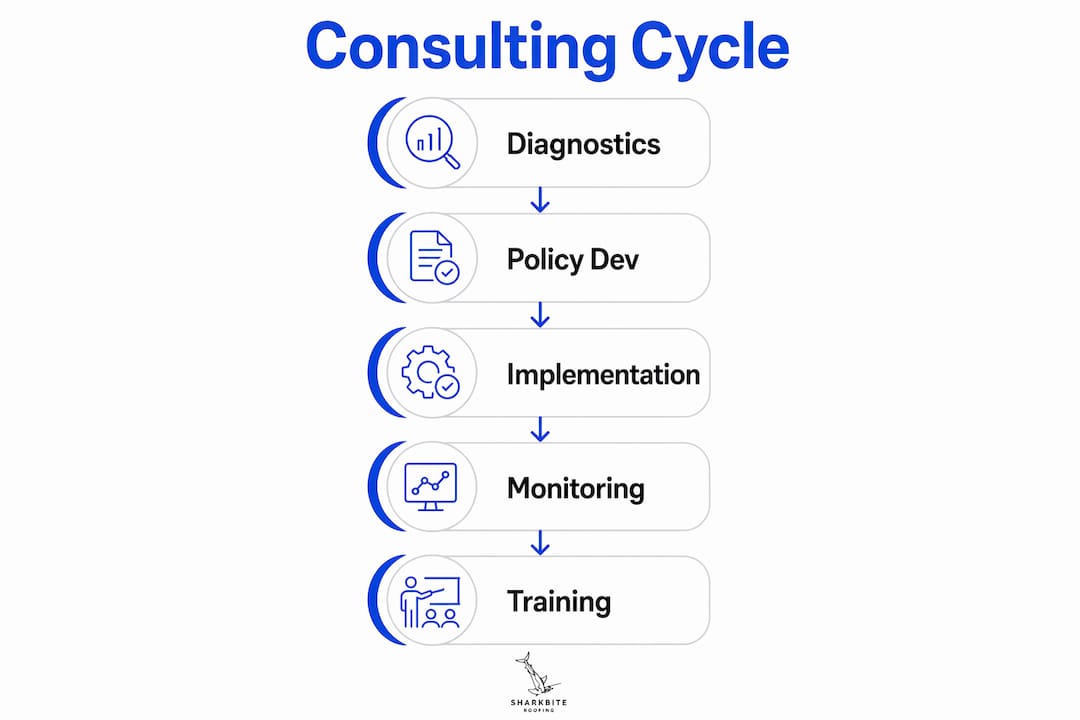
Service delivery follows a structured cycle. Consultants begin with a diagnostics phase to map your current state against applicable regulations. They then design a compliance framework, support implementation, and transition into ongoing managed services. This cycle repeats as regulations change, making the engagement a continuous relationship rather than a single project.

Service domain | Typical activities |
Policy and procedure development | Drafting compliance manuals, internal controls, and standard operating procedures |
Compliance risk assessments | Gap analysis, risk scoring, and regulatory mapping against applicable frameworks |
Monitoring and audit services | AML/CFT audits every 12–18 months, independent testing, and program reviews |
Remediation support | Root-cause analysis, corrective action plans, and regulatory response drafting |
Specialized advisory | Market entry compliance, cross-border regulatory alignment, and ISO/IEC 42001 AI governance |
A Compliance Management System, or CMS, sits at the center of most well-designed programs. It integrates policies, training, monitoring, and reporting into one governed structure. Consultants build or audit the CMS to confirm it meets the standards regulators expect to see during examinations.
Pro Tip: Ask any prospective consulting firm to walk you through a past CMS implementation. If they cannot describe the diagnostics phase in concrete terms, they are selling a template, not a tailored program.
How to select the right regulatory compliance consulting firm
Sector-specific knowledge separates effective consultants from generalist advisors. A firm that understands Singapore’s financial services licensing regime, healthcare product regulations, or technology sector requirements will surface obligations that a generalist will miss entirely. Consultants with sector-specific expertise and certifications like ISO/IEC 42001 for AI governance consistently outperform generalist firms in technology and regulated industry contexts. ISO/IEC 42001 is now a key differentiator as regulators worldwide increase scrutiny of AI-driven business processes.
When evaluating a regulatory and compliance consulting firm, look for these qualifications:
Demonstrated track record in your specific industry and regulatory jurisdiction
Named certifications relevant to your sector, such as ISO/IEC 42001 for AI or recognized AML/CFT credentials
Clear methodology for knowledge transfer to your internal team
References from clients who faced similar regulatory challenges in Singapore or the ASEAN region
Transparent pricing tied to defined deliverables, not open-ended retainers
Red flags are equally telling. Avoid firms that cannot name the specific regulations governing your business, rely entirely on generic templates, or position themselves as the permanent gatekeepers of your compliance program. A good consulting firm builds your capacity. A poor one creates dependency.
Pro Tip: Before signing any engagement letter, ask the firm how your internal team will be able to manage compliance independently after the project ends. Their answer tells you whether they prioritize your long-term success or their own recurring fees.
Strategic regulatory consulting also reveals hidden compliance gaps that traditional financial or legal audits miss, including data integrity issues that can trigger regulatory findings. This is a concrete reason to choose a firm with deep subject matter expertise over one that simply reviews documents.
What are the benefits of proactive regulatory readiness assessments?
Proactive compliance beats reactive compliance on every measurable dimension. Regulatory readiness assessments before market entry or a product launch identify obligations before operations begin, preventing the enforcement actions and reputational damage that follow non-compliance discoveries. Businesses that wait for a regulator’s inquiry to discover gaps pay far more in remediation, legal fees, and lost business than those that assess early.
A structured readiness assessment delivers four concrete benefits:
Obligation mapping. The assessment identifies every applicable regulation, license requirement, and reporting deadline before you are subject to examination.
Gap identification. It surfaces the distance between your current controls and what regulators expect, giving you a prioritized remediation list.
Risk scoring. Each gap receives a risk rating so your team allocates resources to the highest-exposure areas first.
Horizon scanning. The assessment includes a forward-looking review of emerging regulations, so you are not surprised by new requirements six months after launch.
Sustainable compliance is a continuous cycle, not a one-time audit. Regulators update guidelines, new products trigger fresh obligations, and geopolitical shifts create cross-border compliance complexity. Businesses that build ongoing monitoring mechanisms into their operations respond to these changes without scrambling. Those that treat compliance as a project to be completed and filed away face repeated remediation cycles.
The contrast between proactive and reactive approaches is sharpest in financial services. A Singapore-licensed payment institution that conducts annual AML/CFT independent audits and updates its risk assessment upon product changes stays ahead of MAS expectations. One that audits only when prompted by an examination notice typically finds itself managing multiple findings simultaneously, under time pressure, and at significant cost.
What practical steps should you take before engaging compliance consultants?
Preparation before a consulting engagement directly reduces cost and improves outcomes. Early, structured access to internal data allows consultants to conduct meaningful risk assessments and focus on root causes rather than surface symptoms. When data is disorganized or withheld, consultants spend billable hours reconstructing information that your team already holds.
Before your first engagement session, complete these steps:
Compile all existing policies, procedures, and compliance documentation in one accessible location
Categorize your data by business line, regulatory jurisdiction, and risk area
Identify the internal owner for each compliance function so consultants have a named contact for every domain
Document any past regulatory findings, audit results, or enforcement correspondence
Prepare a list of planned product launches, market expansions, or operational changes in the next 12 months
Root-cause analysis is the standard that separates effective consulting from symptom patching. When a consultant identifies a gap, the question is not just “what is missing” but “why does this gap exist and what systemic change prevents recurrence.” Businesses that frame their engagement around root causes get durable fixes. Those that accept surface-level recommendations find the same gaps reappearing at the next audit.
Pro Tip: Assign an internal project lead for every consulting engagement. This person owns the data flow, tracks deliverables, and absorbs the consultant’s methodology. When the engagement ends, your organization retains the knowledge rather than losing it when the consultant departs.
Knowledge transfer is the metric that determines whether a consulting engagement creates lasting value. Consultants should document their frameworks, train your team on monitoring tools, and leave your organization capable of independent compliance management. This is especially relevant for Singapore businesses working with Headington, where the goal is always to build internal capacity alongside external advisory support.
For businesses managing legal services and compliance operations across multiple jurisdictions, the preparation phase also includes mapping which regulatory bodies govern each market and confirming that your internal data structure reflects those distinctions.
Key Takeaways
Effective regulatory compliance consulting services require sector-specific expertise, proactive readiness assessments, and structured knowledge transfer to build lasting internal capacity.
Point | Details |
Five core service domains | Compliance consulting covers policy development, risk assessments, monitoring, remediation, and specialized advisory. |
Sector-specific expertise matters | Generalist firms miss jurisdiction-specific obligations; always verify industry credentials and named certifications. |
Proactive assessments prevent enforcement | Readiness assessments before market entry identify obligations early and reduce remediation costs significantly. |
Structured data preparation reduces cost | Organizing internal data before engagement cuts consulting hours and improves risk assessment accuracy. |
Knowledge transfer is the success metric | Engagements that train internal teams create lasting compliance capacity rather than permanent consultant dependency. |
Why compliance consulting is a long-term investment, not a line item
The businesses I have seen struggle most with compliance share one trait: they treat it as a cost to minimize rather than a function to build. They hire a consultant to close a specific gap, file the report, and move on. Twelve months later, the same gap reappears under a different name, and the cycle repeats at greater expense.
The firms that get this right treat their compliance consultants as a standing resource, not a one-time vendor. They schedule annual readiness reviews, involve consultants early in product development decisions, and use the engagement to train internal staff. The result is a compliance function that grows stronger over time rather than one that perpetually depends on outside help.
One pattern I find consistently underappreciated is the value of horizon scanning. Most businesses focus on current obligations and ignore the regulatory pipeline. Singapore’s regulatory environment moves quickly. The MAS has accelerated its guidance on digital assets, AI governance, and environmental risk disclosures in recent years. Businesses that track these developments before they become binding requirements have months to prepare. Those that wait for the effective date scramble.
External consultants add objective assurance and benchmarking that internal teams genuinely cannot provide on their own. This is not a criticism of internal compliance officers. It is a structural reality. An internal team is too close to the business to stress-test its own assumptions. An external consultant brings the regulator’s perspective, which is exactly what you need before an examination.
The goal is not to outsource your compliance function permanently. The goal is to use consulting engagements to build a program that your team can sustain, monitor, and adapt independently. That is the standard I hold every engagement to, and it is the standard you should demand from any firm you hire.
— Colin
How Headington supports your compliance and risk management needs
Headington brings over 25 years of experience in corporate and legal advisory services across 90 countries, with in-house experts who understand the specific regulatory frameworks that govern businesses in Singapore and the broader ASEAN region.
Whether you need a full regulatory readiness assessment before a market entry, ongoing compliance monitoring for your licensed operations, or specialized advisory on cross-border regulatory alignment, Headington delivers programs built around your specific obligations. The approach centers on building your internal capacity, not creating dependency. Every engagement includes structured knowledge transfer so your team can manage compliance independently after the program concludes. Contact Headington to discuss your regulatory challenges and get a tailored compliance program that fits your business.
FAQ
What are regulatory compliance consulting services?
Regulatory compliance consulting services are professional advisory services that help businesses identify applicable regulations, assess compliance gaps, develop control frameworks, and maintain ongoing adherence to legal and industry requirements.
How often should a business conduct compliance risk assessments?
AML/CFT risk assessments are typically required every 12–18 months or whenever a business launches a new product or service. Other compliance assessments should align with the regulatory review cycles of the applicable governing body.
What is ISO/IEC 42001 and why does it matter for compliance?
ISO/IEC 42001 is an international standard for AI management systems. It serves as a key certification for businesses operating AI-driven processes and helps demonstrate governance maturity to regulators and clients.
How do I know if a compliance consulting firm is qualified?
Verify sector-specific credentials, ask for references from clients in your industry, and confirm that the firm’s methodology includes knowledge transfer to your internal team. Firms that cannot name the specific regulations governing your business are not qualified for your engagement.
What is the difference between a compliance audit and a readiness assessment?
A compliance audit reviews whether your current controls meet existing requirements. A readiness assessment looks forward, identifying obligations before operations begin or before a new regulation takes effect, giving you time to prepare rather than remediate.


Comments