
Outsourced Accounting Services: A Guide for Singapore


Outsourced accounting services are defined as the delegation of a company’s financial operations to an external team of professionals, covering everything from accounts payable and payroll to controller and CFO-level advisory. This model, formally known as Client Accounting and Advisory Services (CAAS), integrates bookkeeping, financial reporting, and strategic guidance into one continuous relationship. Businesses that switch from in-house teams to outsourced finance and accounting services typically save 40–60% on total finance costs. For Singapore businesses operating across borders, this model delivers compliance expertise and real-time financial visibility that a single in-house hire rarely can.
What do outsourced accounting services actually include?
Outsourced accounting goes well beyond recording transactions. Outsourced accounting manages operations like paying bills, sending invoices, and handling sales tax, rather than simply logging what already happened. That distinction matters because it shifts the provider’s role from historian to active financial operator.
The core service categories typically include:
Accounts payable: Processing vendor invoices, managing payment approvals, and maintaining supplier records
Accounts receivable: Sending client invoices, tracking collections, and reconciling incoming payments
Payroll integration: Running payroll cycles, managing CPF contributions in Singapore, and syncing with HR systems
Tax compliance: Preparing GST filings, coordinating with tax advisors, and aligning transaction timing with tax planning
Financial reporting: Producing monthly profit and loss statements, balance sheets, and cash flow reports
CFO advisory: Interpreting financial data to support pricing decisions, funding rounds, and growth planning
The CAAS model replaces the old fragmented approach where businesses hired one firm for bookkeeping and another for tax. A single provider now owns the full financial workflow, which eliminates handoff errors and produces faster month-end closes.
Pro Tip: Start with accounts payable outsourcing before expanding to advisory services. You will build trust with the provider, identify workflow gaps early, and avoid paying for CFO-level services before your business is ready to use them.

How do outsourced accounting services drive cost savings?
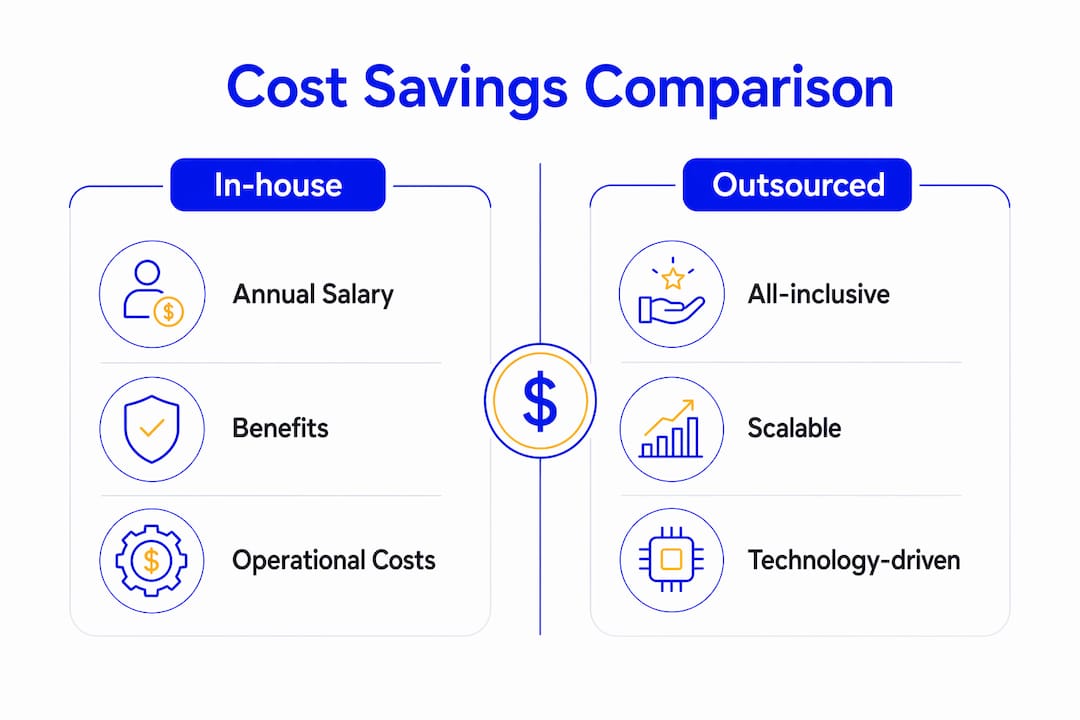
The cost difference between in-house and outsourced teams is significant. In-house accounting staff costs $65,000–$85,000+ per year in salary alone, before benefits, software licenses, and training. Outsourced accounting and bookkeeping services for small and mid-sized businesses typically run $500–$3,500 per month. That pricing range covers far more than one employee’s scope.
“The real value of outsourced accounting is not just the lower invoice. It is the access to a team with a controller, a tax specialist, and a CFO-level advisor, all for less than the cost of one mid-level hire.”
The efficiency gains compound over time. Automated workflows reduce manual data entry, which cuts errors in reconciliations and reporting. Faster month-end closes mean business owners get financial statements in days, not weeks. That speed directly improves cash flow decisions because you are acting on current data, not last quarter’s numbers.
Tax-integrated accounting is one of the most underrated advantages. When the same team handles your books and your GST filings, they can time transactions to minimize tax exposure. A fragmented setup, where one firm does bookkeeping and another does tax, almost always misses these opportunities because neither team sees the full picture.
Cost category | In-house team | Outsourced model |
Annual salary | $65,000–$85,000+ | Included in monthly fee |
Benefits and CPF | 15–20% of salary | Not applicable |
Accounting software | $2,000–$10,000/year | Included in monthly fee |
Training and development | $1,500–$5,000/year | Provider’s responsibility |
Total estimated annual cost | $85,000–$115,000+ | $6,000–$42,000 |
The table above uses salary benchmarks for Singapore-context SMBs. Actual costs vary by business size and service scope.
What role does technology play in modern outsourced accounting?
Cloud-based platforms are the operational backbone of outsourced bookkeeping and accounting services today. Platforms like NetSuite, Sage Intacct, and QuickBooks Online give both the provider and the business owner real-time access to financial data from any device. That visibility eliminates the old problem of waiting for a monthly report to understand your cash position.
Security is not optional in this model. Providers must use encrypted data handling, role-based access controls, and confidentiality agreements as baseline requirements. Role-based access means your payroll data is visible only to the people who need it, not to every member of the provider’s team. Security protocols have evolved to bank-grade encryption, which makes a well-chosen outsourced provider more secure than a spreadsheet stored on a shared drive.
Integration with your existing tools matters as much as the accounting platform itself. A good provider connects the accounting system to your point-of-sale software, payment processors like Stripe or PayNow, and expense management tools. That integration removes manual data transfers, which are the most common source of reconciliation errors.
The key security and technology features to verify before signing with any provider:
Encrypted cloud storage with automatic backups
Role-based access controls limiting data visibility by function
Signed non-disclosure and data processing agreements
Integration capability with your existing POS, payroll, and payment systems
Compliance with Singapore’s Personal Data Protection Act (PDPA) requirements
Pro Tip: Ask any prospective provider to walk you through their data breach response protocol. A provider that cannot answer this question clearly is not ready to handle your financial data.
How should Singapore businesses select and scale outsourced accounting?
Singapore businesses face financial complexity that generic outsourcing providers often miss. Providers must handle multi-currency reporting, multi-entity consolidation, and international regulatory compliance to serve Singapore-based businesses effectively. A provider comfortable with USD-only books will struggle the moment you add SGD, USD, and HKD transactions across three entities.
Follow these steps when evaluating and onboarding a provider:
Audit your current financial operations. Map every recurring task, from invoice processing to payroll runs, and identify where errors or delays most often occur. This baseline tells you which services to outsource first.
Verify GST and cross-border compliance expertise. Ask for examples of clients with similar multi-currency or multi-entity structures. Singapore’s GST rules and IRAS reporting requirements are specific, and a provider without local experience will create compliance risk.
Start with high-volume, low-complexity tasks. Many businesses begin with accounts payable and add advisory services incrementally. This approach lets you test the provider’s reliability before trusting them with strategic decisions.
Assess cultural and operational fit. A provider should adapt to your workflows and regulatory environment, not force you into their generic process. If the onboarding conversation is all about their system and none about yours, that is a warning sign.
Define escalation and communication protocols. Agree on response times, reporting cadences, and who owns each financial process. Ambiguity here causes the most friction in outsourced relationships.
Build in a quarterly review cycle. As your business grows, your accounting needs change. A provider that functions as an extension of your team will proactively recommend adding controller or CFO services when the data shows you need them.
Scalability is the structural advantage of outsourced finance and accounting services that most business owners underestimate at the start. When you open a new market or add a product line, you do not hire a new accountant. You expand the scope of an existing relationship, which is faster and cheaper than recruiting.
Key Takeaways
Outsourced accounting services deliver the most value when treated as a long-term operational partnership, not a cost-cutting measure applied to a single function.
Point | Details |
CAAS replaces fragmented services | The integrated model combines bookkeeping, controller, and CFO support in one provider relationship. |
Cost savings are substantial | Outsourced models typically cost $6,000–$42,000 annually versus $85,000–$115,000+ for in-house teams. |
Start modular, then scale | Begin with accounts payable, then add advisory services as trust and complexity grow. |
Security is non-negotiable | Verify encrypted storage, role-based access, and PDPA compliance before signing any agreement. |
Singapore fit requires specific expertise | Providers must demonstrate competency in GST, multi-currency reporting, and cross-border compliance. |
What I have learned from watching outsourced accounting partnerships succeed and fail
Most businesses that are disappointed with outsourced accounting hired the wrong type of provider. They engaged a firm that offered transactional bookkeeping, got clean records, and then wondered why their financial decisions still felt like guesswork. Avoid providers that only offer transactional bookkeeping. Strategic outsourced accounting includes month-end procedures, variance analysis, and advisory conversations that connect your numbers to your decisions.
The businesses I have seen get the most from this model treat the provider like a department head, not a vendor. They share business context, flag upcoming decisions early, and ask their accounting team what the numbers actually mean. That communication habit is what separates a $500-per-month bookkeeping subscription from a genuine financial partnership.
One pattern I keep seeing in Singapore specifically: business owners assume their provider understands the cross-border complexity of their operations. They do not check until something goes wrong, usually at tax time or during an audit. Vet this explicitly. Ask about multi-entity consolidation, transfer pricing awareness, and IRAS reporting experience before you sign anything.
The shift from fragmented services to an integrated CAAS model is not just an industry trend. It reflects what actually works. When one team owns the full financial picture, they catch problems earlier, advise better, and close the books faster. That is the outcome you are paying for.
— Colin
Headington’s approach to outsourced accounting for Singapore businesses
Headington brings 25+ years of experience and in-house experts across 90 countries to help Singapore businesses manage their financial operations without the overhead of a full internal team.
Whether you need accounts payable support, multi-currency reporting, or CFO-level advisory, Headington’s services adapt to your existing workflows and regulatory environment. Every engagement starts with an operations assessment to identify where your current setup creates risk or inefficiency. From there, the scope grows with your business. If you want to understand what outsourced finance and accounting services could look like for your specific situation, connect with Headington for a no-obligation consultation.
FAQ
What is outsourced accounting services?
Outsourced accounting services involve hiring an external team to manage your company’s financial operations, including accounts payable, payroll, tax compliance, and financial reporting. The modern version of this model, called CAAS, also includes controller and CFO-level advisory support.
How much do outsourced accounting services cost?
Outsourced accounting typically costs $500–$3,500 per month for small and mid-sized businesses, compared to $65,000–$85,000+ per year for a single in-house accountant. Total annual savings commonly reach 40–60% when factoring in benefits, software, and training costs.
What is the difference between bookkeeping and outsourced accounting?
Bookkeeping records past transactions. Outsourced accounting manages active financial operations like paying bills, invoicing clients, and filing taxes, while also providing strategic analysis and advisory support.
How do Singapore businesses choose the right outsourced accounting provider?
Singapore businesses should prioritize providers with demonstrated expertise in GST compliance, multi-currency reporting, and cross-border regulatory requirements. Operational fit matters as much as technical capability, so the provider should adapt to your workflows, not the other way around.
Is outsourced accounting secure?
Reputable providers use bank-grade encryption, role-based access controls, and signed confidentiality agreements to protect financial data. Businesses in Singapore should also confirm that any provider complies with the Personal Data Protection Act (PDPA).


Comments