
IRAS Ready Intercompany Agreements for Singapore Tax, Treasury, Legal


Every Singapore entity transacting with related parties needs a written intercompany agreement that reflects arm’s length pricing and is backed by contemporaneous transfer pricing documentation, in line with IRAS guidance. Get these three things right first: a signed agreement for every material controlled transaction, pricing you can defend under the arm’s length principle, and evidence prepared at the time the transaction happens, not reconstructed later for an audit.
TL;DR:
Proper intercompany agreements must be signed for all material controlled transactions, with pricing that can be defended under the arm’s length principle and supported by contemporaneous evidence.
IRAS requires detailed documentation including a functional analysis, a supported transfer pricing method, and proof that conduct aligns with contractual terms to withstand audit scrutiny.
Loan agreements must establish genuine credit terms with market-based interest rates; small or domestic loans may qualify for simplified benchmarking but still require proper documentation.
Routine support services can benefit from simplified pricing under a 5% cost mark-up, but recipients must demonstrate actual service consumption and applicable cost bases.
Effective controls include a living contract register, direct links between invoices and contractual clauses, and regular review processes to reduce transfer pricing risk.
Table of Contents
Overview: IRAS, the arm’s length principle and Singapore’s transfer pricing framework
Which intercompany agreements matter most for transfer pricing
Drafting essentials: clauses that support an arm’s length position
Intercompany loans: drafting, benchmarking and safe harbours
Headington practice note: controls that reduce transfer pricing risk
Author perspective: prioritising governance over headline pricing
How Headington helps with drafting and transfer pricing readiness
Overview: IRAS, the arm’s length principle and Singapore’s transfer pricing framework
The Income Tax (Transfer Pricing) Rules 2018 require Singapore taxpayers to price related-party transactions as if they were dealing with an independent party under comparable conditions. That’s the arm’s length principle, and it sits at the centre of every intercompany agreement you draft. IRAS doesn’t just want the right number on an invoice. It wants a documented, defensible process showing how that number was reached.
IRAS expects businesses to demonstrate arm’s length outcomes through a structured functional analysis, generally covering three stages:
Identify the transaction and the parties involved, including who bears which functions, assets, and risks.
Select and apply an appropriate transfer pricing method (comparable uncontrolled price, cost plus, resale price, or a profit-based method) supported by benchmarking data.
Test and document the outcome, checking that the resulting margin or price falls within an arm’s length range and keeping the analysis on file.
Where pricing certainty matters, particularly for large or recurring transactions, IRAS’s Advance Pricing Arrangement (APA) programme lets you agree a methodology in advance. The Mutual Agreement Procedure (MAP) is the escape route when a transfer pricing adjustment triggers double taxation across two jurisdictions. Both mechanisms sit under the same transfer pricing framework and reflect the OECD Transfer Pricing Guidelines, which shape how IRAS interprets delineation and benchmarking questions in practice. Singapore’s position closely tracks the OECD’s post-BEPS consensus, so any documentation built to OECD standards will generally satisfy IRAS’s own expectations with only minor local adjustments.
Which intercompany agreements matter most for transfer pricing
Not every intercompany arrangement carries the same risk. Four categories dominate the compliance conversation for Singapore groups, and each demands a different drafting approach.
Service agreements cover management fees, shared services, and support functions. These attract scrutiny when the recharge basis looks arbitrary or the services can’t be shown to have actually happened.
Loan agreements are consistently the highest-risk category, because interest rates are easy for IRAS to benchmark against market data and hard to defend without proper analysis.
Cost contribution arrangements (CCAs) pool costs for jointly developed assets or shared R&D, and need a clear contribution key tied to expected benefit.
IP licence agreements govern royalties for trademarks, patents, or technology, and require evidence that the licensor genuinely controls the underlying value.
The critical distinction within services is between routine support (payroll processing, IT helpdesk, basic admin) and value-adding activities (strategic advisory, bespoke engineering, market-specific R&D). Routine services can often use simplified recharge methods; value-adding work generally needs full benchmarking. A CCA or IP-sharing structure becomes the better fit once multiple entities are jointly funding development of an asset none of them could reasonably justify buying outright from a third party.
Drafting essentials: clauses that support an arm’s length position
An intercompany agreement that exists purely as a formality won’t survive an IRAS review. The document has to mirror what actually happens between the parties, because IRAS weighs economic substance heavily and will adjust pricing where conduct diverges from the contract.
Build every agreement around these clauses:
Scope of services or transaction — describe precisely what is being provided, by whom, and to which recipient entity. Vague scope language is one of the fastest ways to lose an audit argument.
Pricing methodology — state the transfer pricing method used (cost plus, CUP, resale price, or profit split) and reference the benchmarking study that supports it.
Invoicing mechanics — set out frequency, currency, and the calculation basis behind each invoice line.
Payment terms — specify due dates, late payment consequences, and any interest on overdue balances, mirroring what an unrelated party would accept.
Termination rights — include notice periods and conditions for exit that a genuine third-party counterpart would negotiate for.
Dispute resolution — name the governing law (typically Singapore law for locally incorporated entities) and the forum for resolving disagreements.
Commercial realism matters more than legal elegance. If a bank wouldn’t accept an unsecured, interest-free, indefinite-term loan from an unrelated borrower, IRAS won’t accept that structure between related entities either. Build in enforcement rights, security where appropriate, and covenants that reflect genuine credit risk.
Pro Tip: Keep a simple mapping table linking each contractual obligation to the document that proves it happened, timesheets for service hours, delivery confirmations for goods, drawdown notices for loans. When an IRAS query lands, that table turns a scramble into a five-minute retrieval exercise.
The gap between drafting and evidence is where most disputes originate. A well-worded services clause means nothing if nobody can produce the underlying timesheets or project reports when asked. Treat the contract as the skeleton and the operational records as the proof of life.
Structuring intercompany service fees correctly
The chargeability test comes first. A service is only chargeable to the recipient entity if it delivers an identifiable economic benefit, something the recipient would have paid for or performed itself had it been a standalone business. Shareholder oversight activities and duplicate corporate functions generally fail this test and shouldn’t be recharged at all.
Once a service clears that bar, the allocation key needs to reflect how the benefit is actually consumed:
Headcount works well for HR, payroll, and general administrative support.
Transaction volume suits IT systems processing orders or invoices across entities.
Revenue or usage metrics fit marketing support or platform services where benefit scales with commercial activity.
IRAS accepts a simplified 5% cost mark-up for qualifying routine support services, and separately allows the OECD low-value-adding services approach where the relevant conditions are met. Both routes cut down on full benchmarking work, but neither removes the documentation burden.
The 5% figure is a mark-up on cost, not a free pass. You still need to justify why the service qualifies as routine, show the cost pool that the mark-up applies to, and demonstrate the allocation key is rational. Contemporaneous evidence that recipients actually consumed the service remains essential even under the simplified approach; auditors ask for proof of performance before they accept the pricing shortcut.
Intercompany loans: drafting, benchmarking and safe harbours
Loans between related Singapore entities attract more scrutiny than almost any other intercompany transaction, because interest rates are the easiest thing for a tax authority to test against public market data. Loan agreements need to function as genuine credit instruments, not accounting entries dressed up in legal language.
Structure the drafting and analysis in this order:
Draft the core commercial terms first — principal amount, tenor, a clearly defined interest formula (fixed, floating with a named benchmark, or a margin over a reference rate), repayment schedule, covenants, and the ranking or security position relative to other creditors.
Assess the borrower’s credit profile — a genuine lender prices risk based on the borrower’s standalone creditworthiness, not the parent group’s rating, unless an explicit guarantee changes that risk position.
Benchmark the interest rate — use an internal CUP (a comparable loan the group has taken from or given to an unrelated party) where one exists, or an external CUP built from market data adjusted for currency, tenor, and credit rating differences.
A two-step approach, a properly drafted agreement paired with a robust transfer pricing analysis, is what regional practitioners recommend to cut dispute risk on cross-border intercompany loan agreements. IRAS does allow indicative margins and administrative relief for certain domestic related-party loans below defined thresholds, which can reduce the benchmarking burden for smaller transactions, though the underlying agreement still needs to hold up on its own terms. Watch out for withholding tax and currency exposure too; loan tenor and structure affect both the tax treatment and the practical treasury mechanics of cross-border lending.
Documentation, contemporaneous evidence and audit risks
IRAS expects transfer pricing documentation at both group and entity level, and may require supplementary entity-specific documentation where the group-level file doesn’t adequately address a Singapore entity’s specific facts. A complete file typically includes the group’s organisational structure, a functional analysis of each entity’s role, the pricing methodology applied to each material transaction, and the benchmarking study supporting it.
Certain patterns reliably trigger audit attention:
Generic, round-number invoices with no calculation basis behind them.
Allocation keys that don’t map to any documented rationale.
Missing evidence that a service was actually performed — no timesheets, no deliverables, no correspondence trail.
Pricing that drifts from the contract terms over time without any amendment being documented.
Practitioner commentary consistently notes that invoices and billing statements alone are never a substitute for a written intercompany agreement, and that IRAS often looks past the paperwork to actual conduct when assessing an audit case. Where a review uncovers gaps, the corrective options include furnishing supplementary documentation promptly, adjusting the pricing methodology going forward, or pursuing an APA to lock in certainty for future periods. Penalties for inadequate documentation can be significant, so treating documentation as a live, ongoing task rather than a year-end scramble pays off directly.
Pro Tip: Run a mock audit internally once a year, pick three transactions at random and ask your own team to produce the full evidence trail within 48 hours. Whatever takes longest to find is exactly what an IRAS officer will ask for first.
Practical compliance checklist and timeline
Building audit-ready agreements works best as a repeatable annual cycle rather than a one-off project.
Set the transfer pricing policy — finance and tax teams agree the group’s pricing methodology for each transaction category.
Draft or refresh the agreements — legal drafts or updates each contract to reflect the current policy and commercial reality.
Obtain board or delegated approval — corporate secretarial processes should record formal authorisation for each material intercompany arrangement.
Compile contemporaneous documentation — tax teams gather the functional analysis and benchmarking study before the transaction year closes, not after.
Review annually — reassess pricing and documentation whenever the group’s operating model, entity functions, or market conditions shift materially.
Ownership matters as much as the steps themselves. Tax typically owns the pricing methodology and benchmarking, legal owns the contract drafting and clause accuracy, and treasury owns the loan mechanics and covenant tracking. IRAS documentation generally needs to be ready by the time the tax return is filed, and any request for supplementary information during a review usually comes with a defined response window, so keeping the file current avoids a last-minute crunch.
Template elements and drafting red flags to avoid
A good template saves drafting time, but only if it’s adapted rather than copied wholesale. For service agreements, check the template includes a defined pricing formula, a named allocation key, and a schedule for evidencing performance. For loan agreements, confirm it addresses applicable law references and statutory flags such as GST treatment and corporate authorisations relevant to Singapore-incorporated borrowers. CCA templates need a contribution key tied to expected benefit share, not just cost split evenly by headcount.
Watch for these red flags in any template or draft:
Overly broad scope language that could cover almost any activity.
No stated pricing rationale, just a flat fee with no method behind it.
Termination clauses that no independent party would ever accept.
Missing GST treatment notes on cross-border or exempt supplies.
Simple, low-value, high-volume arrangements can usually run on a well-adapted template. Anything involving IP, cross-border loans above a material threshold, or a novel business model deserves bespoke drafting from someone who understands both the commercial deal and the transfer pricing implications.
Headington practice note: controls that reduce transfer pricing risk
Across cross-border engagements, the same weaknesses recur: contracts that were signed once and never updated, invoices that don’t match any documented allocation key, and loan agreements missing a genuine interest benchmark. Fixing this usually comes down to three operational controls: a live contract register that flags renewal and review dates, a direct link between each invoice line and its contract clause, and an annual transfer pricing recheck whenever the group’s structure or functions change.
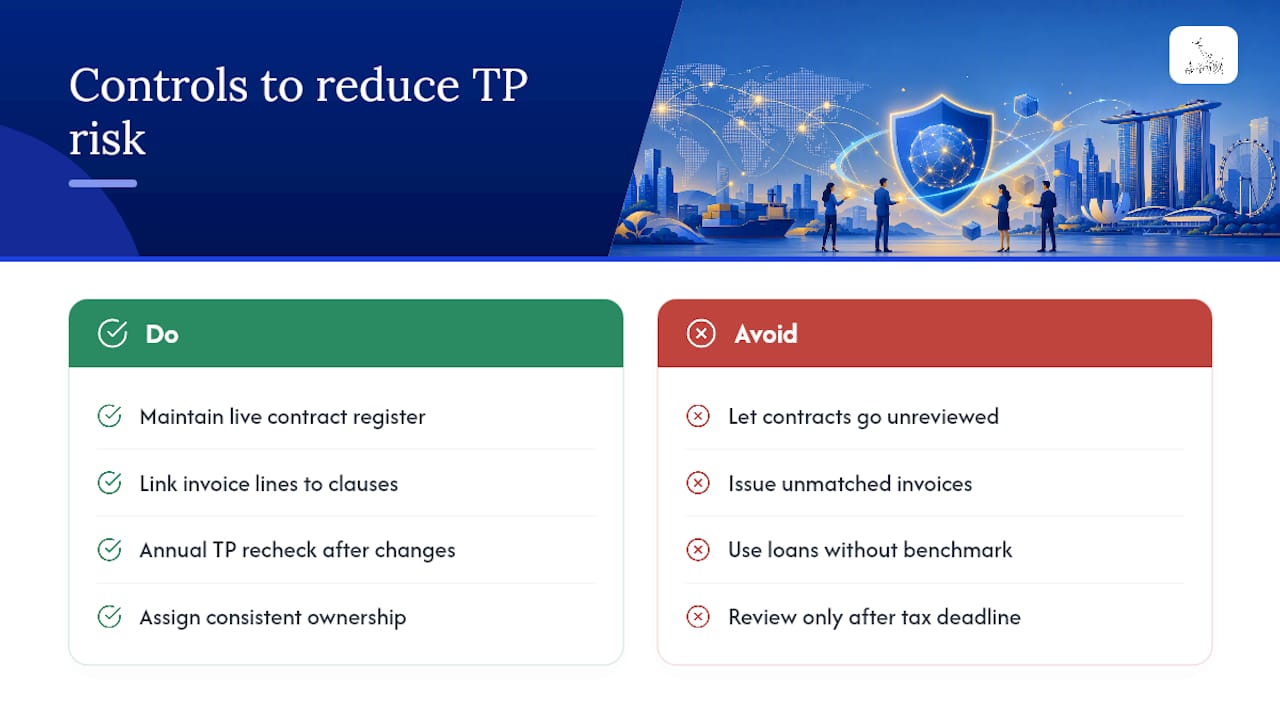
None of this requires elaborate systems, just consistent ownership. Fixed-fee starter documentation, proper corporate authorisation trails, and a discipline of reviewing agreements before the tax return deadline, not after, close most of the gaps that turn into IRAS queries.
How GST applies to intercompany transactions in Singapore
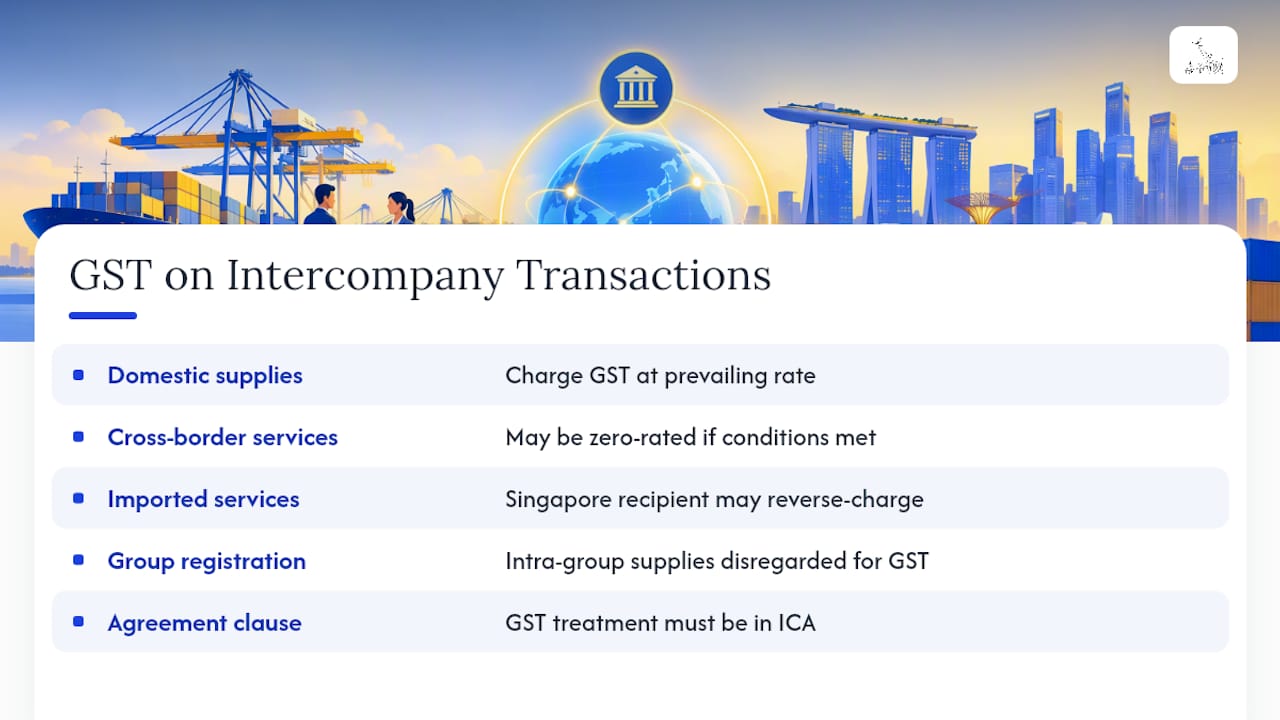
Goods and Services Tax sits alongside transfer pricing as a separate compliance layer, and it’s easy to overlook when the focus is on income tax pricing. GST-registered entities generally need to charge GST on standard-rated intercompany supplies of services or goods made within Singapore, at the prevailing rate, even where the transaction is between related parties within the same group.
Cross-border intercompany services supplied to an overseas related entity may qualify for zero-rating if the recipient belongs outside Singapore and the service meets the relevant conditions, while imported services received from an overseas related entity can trigger reverse charge obligations for the Singapore recipient under the reverse charge regime. Getting this wrong is common precisely because transfer pricing and GST teams often work in isolation, agreeing an arm’s length fee without checking how it should be treated for GST purposes.
Group registration is available for qualifying Singapore entities under common control, which can simplify GST accounting on intra-group supplies by disregarding them for GST purposes between registered members. That’s worth exploring early if your group runs several Singapore-incorporated entities trading heavily with each other, since it removes a layer of invoicing complexity without touching the underlying transfer pricing position. Whatever structure you choose, the GST treatment clause belongs in the intercompany agreement itself, not left to whoever happens to be raising the invoice that month.
Author perspective: prioritising governance over headline pricing
The instinct in most finance teams is to chase the tightest possible margin and worry about paperwork later. That’s backwards. IRAS rarely penalises a defensible price that sits slightly outside the median of a benchmarking range. It penalises the absence of a coherent story connecting contract, conduct, and evidence. Integrate legal, tax, and treasury controls now, and the pricing debate becomes far easier to win later.
— Colin
How Headington helps with drafting and transfer pricing readiness
Getting from policy to a fully documented, board-approved set of intercompany agreements usually runs through four phases: a diagnostic review of existing contracts and pricing, drafting or updating the agreements themselves, formal corporate approval, and ongoing monitoring as the group’s structure evolves. Such processes typically require extensive experience and multi-jurisdictional coverage, which is important when a Singapore holding company manages operating entities in several countries and needs consistent contract language across all of them.
Headington’s business agreement drafting service covers the contract layer directly, while the broader corporate secretarial, filing agent, and documentation services handle the approvals, registers, and cross-border administration that keep agreements audit-ready year after year. Where intercompany data flows raise PDPA questions alongside the transfer pricing analysis, the data protection compliance services close that gap too. If your current agreements were signed once and forgotten, book a diagnostic review through Headington’s expertise page and get a clear picture of what needs updating before the next filing deadline.
Sources
FAQ
What is an intercompany agreement?
An intercompany agreement is a written contract between two entities within the same corporate group, such as a parent and subsidiary, setting out the terms of a service, loan, licence, or cost-sharing arrangement between them. In Singapore, it also serves as the primary evidence that a related-party transaction was priced on an arm’s length basis for IRAS purposes.
Can you give an example of an intercompany agreement?
A common example is a management services agreement where a Singapore holding company charges a regional subsidiary a fee for shared HR, IT, and finance support, calculated using a headcount-based allocation key with a cost-plus mark-up. Another frequent example is an intercompany loan agreement where a treasury centre lends working capital to an operating entity at a benchmarked interest rate with defined repayment terms.
How does transfer pricing affect intercompany loans?
Transfer pricing rules require the interest rate on an intercompany loan to reflect what an unrelated lender would charge, based on the borrower’s credit profile, the loan’s tenor, and comparable market rates. Loan agreements need clear terms and a robust benchmarking analysis because interest rates are among the easiest transactions for IRAS to test against public data.
Who can incorporate a company in Singapore?
Any individual who meets legal requirements, or any corporate entity, can incorporate a Singapore company, though the company needs at least one director who is ordinarily resident in Singapore. Headington’s corporate secretarial and entity establishment services handle the incorporation process and ongoing statutory compliance for both local founders and foreign groups setting up a Singapore entity.
What documentation does IRAS expect for intercompany agreements?
IRAS expects contemporaneous transfer pricing documentation covering the group’s structure, a functional analysis of each entity, the pricing method applied, and supporting benchmarking data, prepared at group and entity level under the Income Tax (Transfer Pricing) Rules. Written agreements should mirror this documentation and reflect actual conduct, since invoices alone are not treated as sufficient evidence in a review.


Comments