
17% Is Just the Headline: Singapore Corporate Tax for SMEs (YA 2026)

Updated: Oct 1

Singapore’s headline corporate income tax rate is 17% on chargeable income, applied equally to local and foreign companies. Very few businesses actually pay that in full: the partial tax exemption, the start-up tax exemption, and the YA 2026 corporate income tax rebate all reduce the effective figure. The Inland Revenue Authority of Singapore (IRAS) remains the definitive source for how these reliefs stack.
TL;DR:
Most companies in Singapore pay far less than the 17% headline rate due to exemptions like partial tax exemption and start-up tax exemption, which can completely eliminate tax on significant portions of income.
The exemptions are automatically applied during filing, with the sequence being deductions first, then tax at 17%, followed by rebates or cash grants, which must be carefully accounted for to estimate liability accurately.
Eligibility for SUTE depends on proper classification of business activity and shareholder structure at incorporation, with misclassification risking retroactive disqualification and reduced benefits.
Singapore’s tax residency is based on management control within the country, affecting treaty benefits and exemption eligibility, and must be supported by proper documentation and actual decision-making presence.
Filing deadlines and proper record-keeping are critical to maintain compliance, with proactive engagement of advisers recommended for complex residency or exemption questions.
Table of Contents
What is the corporate tax rate in Singapore, and how is it applied?
Partial tax exemption and start-up tax exemption: the reliefs that actually move the needle
Tax residency: what makes a company resident, and why it matters
Filing, assessment, and payment: forms, deadlines, and practical tips
How Headington helps: practical steps and evidence of experience
Beyond exemptions: other corporate tax incentives worth knowing
Recent and upcoming changes to Singapore’s corporate tax policy
Corporate tax rate Singapore: quick facts at a glance
Before working through the mechanics, here’s the shape of the system as it stands for Year of Assessment (YA) 2026.
Headline rate: 17% flat, applied to chargeable income, identical for local and foreign-owned companies.
Partial tax exemption (PTE): 75% exemption on the first S$10,000 of normal chargeable income, plus 50% on the next S$190,000, available to all companies regardless of age.
Start-up tax exemption (SUTE): a richer version of PTE for qualifying new companies in their first three Years of Assessment, exempting 75% of the first S$100,000 and 50% of the next S$100,000.
YA 2026 rebate: a percentage rebate on tax payable, applied after the 17% rate and after exemptions, with a cash grant for smaller active companies that fall below the rebate’s cap.
The order matters more than any single number here. IRAS applies exemptions to chargeable income first, then charges tax at 17%, and only then applies any rebate. Get that sequence wrong and your own estimate of tax payable will be off, sometimes substantially.
What is the corporate tax rate in Singapore, and how is it applied?
Chargeable income is profit after allowable deductions, capital allowances, and any brought-forward losses or exemptions have been factored in. A company can report a healthy revenue figure and still have a modest chargeable income once depreciation, staff costs, and other deductible items are stripped out.
Singapore taxes companies on a preceding year basis. Income earned in the financial year ending in, say, 2025 gets assessed and taxed in YA 2026. This one-year lag surprises founders coming from jurisdictions that tax on a current-year basis, and it’s worth building into your cash flow planning rather than discovering it at filing time.
The calculation always follows the same three-step order:
Apply the relevant exemption (PTE or SUTE) to reduce chargeable income.
Tax the resulting figure at the flat 17% rate.
Apply any corporate income tax rebate to arrive at final tax payable.
This sequencing isn’t a suggestion. It’s how IRAS’s own guidance on rates, rebates and exemption schemes structures every worked example it publishes, and it’s how your Notice of Assessment will be calculated.
There’s no tiered band structure the way personal income tax works, and no separate rate for foreign-owned entities versus locally incorporated ones. Residency status affects eligibility for certain treaty benefits and exemptions, covered further down, but it doesn’t change the headline rate itself. The Ministry of Finance (MOF) frames this flat structure as deliberate policy, designed to keep the system simple while incentives and concessions do the targeted work of encouraging specific activities.
Partial tax exemption and start-up tax exemption: the reliefs that actually move the needle
Two exemption schemes sit between the headline rate and what most companies actually pay, and they work on the same principle but at very different scales.
Partial tax exemption (PTE) is available to every company, regardless of how long it has been trading. It exempts 75% of the first S$10,000 of normal chargeable income and 50% of the next S$190,000, giving a maximum exempted amount of S$102,500 on S$200,000 of chargeable income, according to Data.
Start-up tax exemption (SUTE) is more generous but time-limited and conditional. Qualifying new companies get 75% exemption on the first S$100,000 of chargeable income and 50% on the next S$100,000, for each of their first three Years of Assessment, as set out in IRAS’s basic guide to corporate income tax.
Scheme | First tranche exempt | Next tranche exempt | Maximum exemption |
Partial tax exemption (PTE) | 75% of first S$10,000 | 50% of next S$190,000 | S$102,500 |
Start-up tax exemption (SUTE) | 75% of first S$100,000 | 50% of next S$100,000 | S$100,000 |
Two exclusions catch out founders regularly. Investment holding companies don’t qualify for SUTE, and neither do companies whose principal activity is property development, regardless of how the company is otherwise structured. Misclassifying your primary business activity on incorporation documents is one of the most common reasons a start-up loses SUTE eligibility retroactively, so getting that classification right at the outset matters.
Here’s the practical effect.
Pro Tip: IRAS applies PTE and SUTE automatically based on your filing data, not through a separate application. The real work is making sure your shareholder register and stated business activity accurately reflect your eligibility before you file, because there’s no retroactive fix once the exemption is denied on assessment.
YA 2026 corporate income tax rebate and cash grant
Budget measures for recent Years of Assessment, including YA 2026, have included a percentage-based corporate income tax rebate applied on top of the exemptions above, according to IRAS’s published rebate rates.
The rebate mechanism works in this order:
Chargeable income is reduced by PTE or SUTE as applicable.
The remaining amount is taxed at the flat 17% rate.
The rebate percentage is applied to that tax figure, subject to a cap per company.
Companies whose rebate would fall below a set threshold receive a minimum cash grant instead, historically pitched at S$2,000 for qualifying active companies, so that even loss-making or marginally profitable businesses see some benefit.
Applying a rebate percentage against that figure, capped at the relevant ceiling, reduces the final tax bill directly. A smaller company with only S$3,000 of tax payable, where the calculated rebate would fall short of the S$2,000 cash grant floor, typically receives the cash grant instead of the percentage rebate.
The cash grant exists specifically to support smaller and less profitable companies that don’t generate enough tax payable for the percentage rebate to be meaningful. It’s paid automatically to eligible companies based on their filed returns, with no separate claim process required.
How to calculate your company’s corporate tax, step by step
Work through the calculation in the same order IRAS uses, and you’ll never be surprised by your Notice of Assessment.
Determine chargeable income. Start with accounting profit, add back non-deductible expenses, deduct capital allowances and any available losses carried forward.
Apply the relevant exemption. Use SUTE if you qualify (first three YAs, meeting shareholder conditions), otherwise apply PTE.
Calculate tax at 17%. Apply the flat rate to the exemption-adjusted chargeable income.
Apply the rebate or cash grant. Reduce the tax payable figure by the applicable rebate percentage, subject to the cap, or substitute the cash grant if you fall below the floor.
A worked example makes this concrete. Consider a trading company in its second Year of Assessment, qualifying for SUTE, with S$300,000 of chargeable income.
Step | Calculation | Result |
Chargeable income | Starting figure | S$300,000 |
SUTE exemption | S$75,000 + S$50,000 exemption | S$100,000 exempted |
Taxable income | S$300,000 − S$100,000 | S$200,000 |
Tax at 17% | S$200,000 × 17% | S$29,750 |
After rebate (illustrative) | Rebate applied to tax payable | Reduced final figure |
That gap between headline and effective rate is the single most misunderstood part of Singapore’s corporate tax regulations among founders new to the system.
Tax residency: what makes a company resident, and why it matters
A company is tax resident in Singapore when its management and control is exercised here, not based on where it was incorporated. IRAS’s guidance on tax residency treats this as a factual question, assessed year by year, rather than a one-off determination made at incorporation.
The evidence IRAS looks at is practical, not theoretical:
Where board meetings are actually held, and whether minutes reflect substantive decision-making rather than rubber-stamping.
Where key strategic decisions, such as major contracts or financing, are genuinely made.
Whether directors with real decision-making authority are based in Singapore or attend meetings here.
Whether the company maintains genuine operational substance locally, rather than a registered address alone.
Residency status matters well beyond a compliance checkbox. It affects eligibility for tax treaty benefits, access to certain incentive schemes, and in some circumstances, can influence exemption eligibility depending on how a company’s structure interacts with SUTE’s conditions. A company incorporated in Singapore but managed entirely from overseas can find itself non-resident, losing access to benefits it assumed it had.
The most common mistake finance teams make is treating incorporation as equivalent to residency. It isn’t. If your board is scattered across multiple jurisdictions and meets by video call with no Singapore-based decision-maker present, document that carefully or reconsider the arrangement, because IRAS can and does query residency status where the paper trail looks thin.
Filing, assessment, and payment: forms, deadlines, and practical tips
Singapore’s preceding year basis means the income your company earns in a given financial year is assessed in the following Year of Assessment. A financial year ending 31 December 2025, for instance, falls under YA 2026.
Two forms cover the filing itself. Form C-S is the simplified return, available to companies with straightforward affairs and annual revenue below a set threshold. Form C is the full return required for companies that don’t qualify for the simplified version, typically larger or more complex entities.
Practical filing tips worth building into your annual calendar:
File on time even if your tax position is uncertain; late filing penalties apply regardless of whether tax is ultimately owed.
Keep shareholder registers current throughout the year, not just at filing time, since SUTE eligibility depends on shareholder composition at the relevant point.
Reconcile your stated principal business activity against actual operations annually, particularly if the business has diversified since incorporation.
Retain board meeting minutes and evidence of where key decisions were made, in case residency is ever queried.
Pro Tip: Don’t wait until your filing deadline to check whether you still qualify for SUTE or PTE. A shareholder change mid-year, or a shift in business activity towards property or investment holding, can silently disqualify you from an exemption you were relying on in your budgeting.
How Headington helps: practical steps and evidence of experience
With decades of experience and in-house experts covering many countries, Professional advisers support companies working through exactly these questions: whether a structure meets the residency test, whether shareholder composition preserves SUTE eligibility, and what documentation IRAS expects to see.
Typical advisory work includes residency assessments backed by board-meeting documentation, shareholder structuring to protect exemption eligibility, and preparing the supporting paperwork that makes a filing defensible if queried. Before engaging any adviser on this, it helps to have your shareholder register, latest financial statements, and a clear statement of your principal business activity ready to hand over.
How corporate tax interacts with GST and withholding tax
Corporate income tax doesn’t operate in isolation. Two other taxes regularly intersect with it, and confusing the three is a common source of compliance errors.
Goods and Services Tax (GST) is a separate consumption tax charged on the supply of goods and services, currently registered mandatorily once turnover crosses the prescribed threshold. GST is collected and remitted regardless of whether your company is profitable, and it has no bearing on your chargeable income calculation for corporate tax purposes. A loss-making company can still carry a full GST filing obligation.
Withholding tax applies to specific payments made to non-residents, such as interest, royalties, and certain service fees. When your company pays a foreign vendor or licensor, you may be required to withhold tax at source and remit it to IRAS before the payment leaves Singapore. This is deducted from the payment itself, not from your own chargeable income, but it directly affects cash flow and contract structuring with overseas counterparties.
The interaction that catches companies out most often involves related-party transactions. A payment to an overseas parent or affiliate for management services can trigger withholding tax obligations even where no equivalent corporate tax deduction issue arises, and getting the classification wrong on either side creates two separate compliance exposures rather than one. Structuring cross-border payment flows with both taxes in mind, rather than treating corporate tax and withholding tax as unrelated line items, avoids a good deal of downstream correction work.
Beyond exemptions: other corporate tax incentives worth knowing
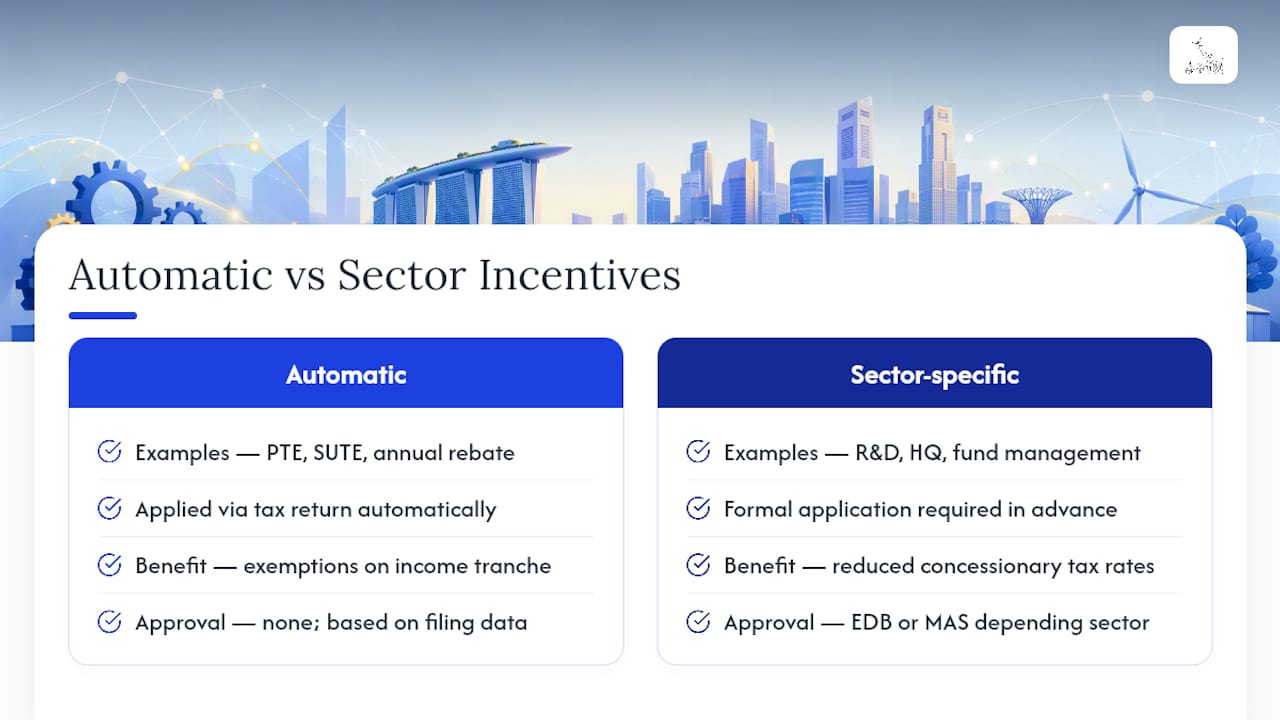
PTE, SUTE, and the annual rebate get the most attention, but Singapore runs a broader suite of concessionary tax schemes aimed at specific activities and sectors. These generally offer reduced tax rates, rather than exemptions on a tranche of income, and typically require a formal application rather than automatic application through your tax return.
Common categories include incentives for companies undertaking qualifying research and development activity, schemes supporting regional or international headquarters functions, and concessionary rates for specific financial services and fund management activities. Each carries its own eligibility criteria, approval process, and minimum commitment thresholds, generally administered through the Economic Development Board or the Monetary Authority of Singapore depending on the sector.
The practical distinction that matters for planning purposes: PTE, SUTE, and the annual rebate apply automatically once your filing data supports them, requiring no separate application. Sector-specific incentives almost always require proactive application, often well before the activity in question begins, and frequently come with conditions around headcount, spending commitments, or business plans that must be maintained for the incentive to continue applying in later years.
For a growing company weighing whether a sector incentive is worth pursuing, the calculation isn’t just about the reduced rate on offer. It’s whether the compliance overhead and ongoing commitment conditions are proportionate to the tax saved, particularly for a smaller company where SUTE alone may already deliver a meaningful reduction in effective tax rate without any additional application burden.
Do dividends affect your company’s corporate tax bill?
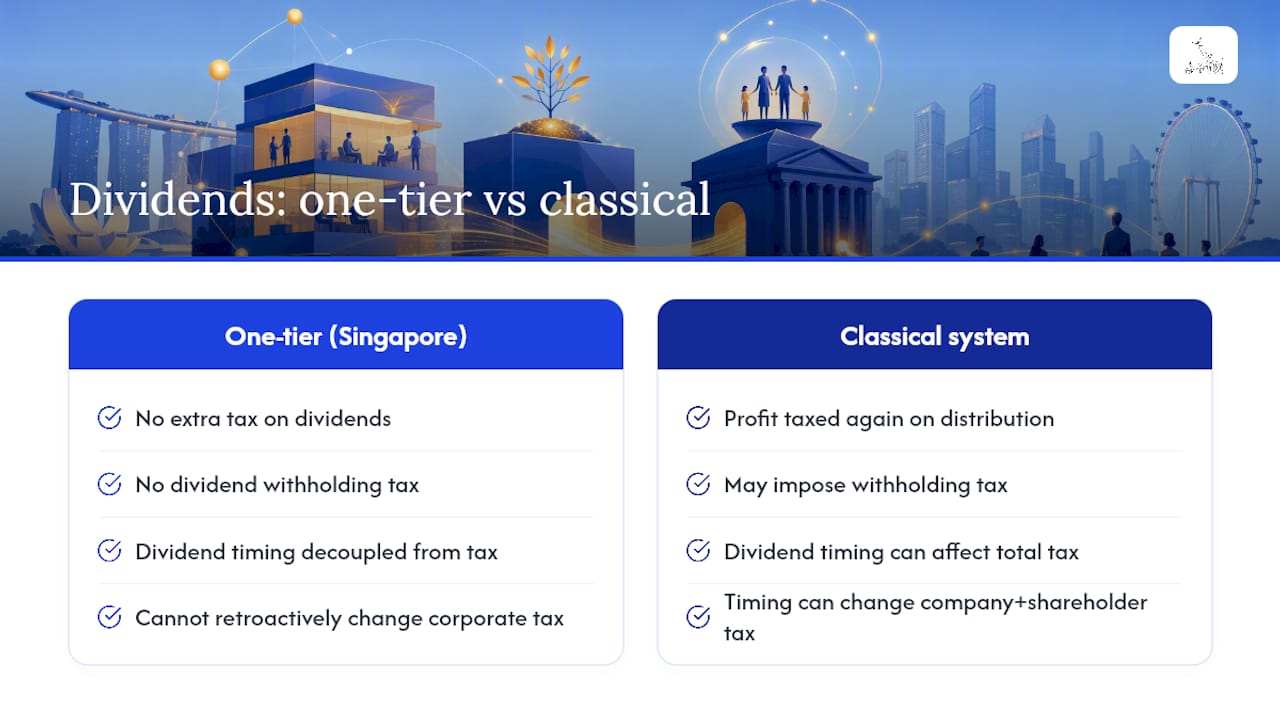
Singapore operates a one-tier corporate tax system, and this is one of the more genuinely favourable features of the regime for shareholders. Once corporate tax has been paid at the company level, dividends distributed to shareholders are exempt from further tax in the shareholders’ hands, whether those shareholders are individuals or other companies.
This means there’s no dividend withholding tax on distributions to shareholders, and no additional layer of tax when profits are paid out. Compare that to jurisdictions running classical dividend tax systems, where profit gets taxed at the corporate level and again when distributed, and the one-tier structure looks like a genuine structural advantage rather than a marketing point.
For finance teams, the practical implication is that dividend timing and corporate tax planning are largely decoupled. Deciding when to distribute profit doesn’t create an additional tax event, so the decision can be driven by cash flow, shareholder needs, or capital retention strategy rather than tax minimisation. That said, the corporate tax itself, including the effect of PTE, SUTE, and the annual rebate, has already been finalised by the time profits reach the distribution stage. There’s no way to retroactively adjust the corporate tax bill through how or when dividends are paid.
One nuance worth flagging for companies with foreign shareholders: while Singapore doesn’t withhold tax on the dividend itself, the shareholder’s own home jurisdiction may still tax that dividend income under its own rules. That’s a matter for the shareholder’s home tax position, not something Singapore’s corporate tax framework controls.
Recent and upcoming changes to Singapore’s corporate tax policy
The headline 17% rate has held steady for well over a decade, tracing back to a reduction from 22% around 2003, moving down in stages to reach 17% by 2010, according to data.gov.sg’s historical tax rate records. Since then, the government’s adjustments have come through targeted rebates and exemption threshold changes rather than shifts to the headline rate itself.
The YA 2026 rebate structure continues that pattern: a temporary, budget-driven relief mechanism layered on top of a stable underlying rate, rather than a permanent change to how much tax companies owe on paper. This approach gives the government flexibility to respond to economic conditions in a given year, offering more generous rebates when businesses need support, without disturbing the predictability that comes from a rate businesses can plan around years in advance.
For finance teams and founders, the practical takeaway is that policy attention should focus less on the headline rate itself, which has proven remarkably stable, and more on the annual Budget announcements covering rebates, exemption thresholds, and sector incentives.
Practical takeaways for finance teams
Three actions belong on every finance team’s list this Year of Assessment: confirm your residency position with proper board documentation, verify your SUTE or PTE eligibility against your current shareholder register rather than assumptions from incorporation, and review your filing timeline early enough to fix problems before the deadline, not after.
Document board decisions as they happen, not retrospectively when IRAS asks. And where the rules feel genuinely ambiguous, particularly around residency or shareholder structuring, engage an adviser before filing rather than after receiving a query.
— Colin
How Headington supports your corporate tax position
Getting SUTE eligibility, residency documentation, and filing timelines right takes more than reading IRAS guidance once a year. Singapore-based businesses and companies expanding into Singapore may access tax, corporate secretarial, and legal advisers who handle these questions, rather than a generic compliance checklist.
Services can cover entity setup, ongoing corporate secretarial support, residency and tax structuring advice, and hands-on assistance preparing the documentation IRAS expects when exemption eligibility or residency status is queried. Clients typically come away with clarity on which exemptions genuinely apply to their structure, a shareholder register and board documentation that will hold up under scrutiny, and filings completed well ahead of deadline rather than in a last-minute scramble. If you’re setting up a new entity, this guide on starting a business without a large technical team is a useful companion read for founders who are structuring their company from scratch.
If your business is approaching a new Year of Assessment with uncertainty about residency status, exemption eligibility, or filing readiness, get in touch with Headington for a consultation and put those questions to rest before they become a filing problem.
This article is general information, not a substitute for advice from a qualified financial advisor. Consult a qualified financial professional about your own circumstances before acting on anything here.
Sources
FAQ
What corporate tax exemptions are available in Singapore?
The two main schemes are the partial tax exemption (PTE), open to all companies, and the start-up tax exemption (SUTE), available to qualifying new companies for their first three Years of Assessment. Both are applied automatically by IRAS based on your filed return, with no separate application needed.
How do I calculate corporation tax in Singapore?
IRAS’s basic guide to corporate income tax sets out worked examples using this exact sequence.
What is the corporate income tax rebate for YA 2026?
Exact percentages and caps are published in IRAS’s corporate income tax rates page.
How do you work out a company’s effective tax rate?
Divide the final tax payable, after exemptions and any rebate, by total chargeable income before those reliefs were applied.
Does Singapore’s corporate tax rate differ for foreign-owned companies?
No.


Comments