
Singapore Transfer Pricing: A Compliance Guide for Business Owners


If your company does related-party transactions in Singapore, your single most urgent action is this: apply the arm’s length principle to every intercompany transaction and prepare contemporaneous transfer pricing documentation before you file Form C. Three things to do right now:
Prepare or review your transfer pricing documentation for the current financial year, including master file, local file, and Country-by-Country Report (CbCR) where applicable.
Review all related-party transactions against the arm’s length standard and flag any that lack pricing support.
Consult a transfer pricing advisor if you have complex intangibles, financing arrangements, or integrated supply chains.
The governing authorities are the Inland Revenue Authority of Singapore (IRAS), the Income Tax Act (Sections 34D, 34E, and 34F), and the Income Tax (Transfer Pricing Documentation) Rules 2018. These three sources define your obligations, your exemptions, and your exposure.
Key Takeaways
Singapore transfer pricing compliance requires contemporaneous documentation prepared before the Form C filing date, with IRAS able to request submission within 30 days and a 5% surcharge applying to any adjustment made under Section 34D.
Point | Details |
Arm’s length principle | Every related-party transaction must be priced as if between independent parties; IRAS follows OECD guidelines. |
Contemporaneous documentation | Prepare master file, local file, and CbCR (where applicable) before the Form C filing due date, not after an audit notice. |
30-day submission window | IRAS expects documentation within 30 days of request; not having it ready is a primary audit trigger. |
5% surcharge on adjustments | From YA 2019, a 5% surcharge applies to any transfer pricing adjustment under Section 34D, regardless of additional tax payable. |
Headington advisory support | Headington provides transfer pricing risk assessments, documentation drafting, benchmarking, and APA support for Singapore entities. |
Table of Contents
When does the Income Tax Act require transfer pricing documentation?
What must contemporaneous transfer pricing documentation contain?
What IRAS simplification measures can reduce your compliance burden?
How does IRAS make adjustments, and what is the 5% surcharge?
How do Singapore’s tax treaties interact with transfer pricing rules?
How to prepare for and respond to an IRAS transfer pricing audit
Headington can help you get Singapore transfer pricing right
What does transfer pricing in Singapore actually cover?
Transfer pricing refers to the prices set for transactions between related parties, such as a Singapore subsidiary selling goods to its parent company overseas, or a local entity charging a related company for management services. The arm’s length principle requires those prices to reflect what independent parties would agree to under comparable conditions. IRAS applies this standard to all related-party transactions, and it follows the OECD Transfer Pricing Guidelines as its primary interpretive authority.
Who counts as a related party? The definition is broad:
Companies under common control (direct or indirect)
A company and its branch or head office
Entities where one party controls the other through shareholding, voting rights, or the ability to influence management decisions
Individuals and entities connected through family or business relationships that create control
The transaction types that typically draw IRAS scrutiny include:
Sale or purchase of goods and raw materials
Provision of services (management, administrative, technical)
Licensing or transfer of intangibles (patents, trademarks, know-how)
Intercompany loans and financing arrangements
Cost-sharing and cost-pooling arrangements
Royalty payments
Bundled transactions where multiple elements are priced together
The arm’s length principle applies to all of these. If your Singapore entity pays a royalty to a related overseas IP holder, IRAS expects you to demonstrate that the royalty rate is consistent with what unrelated parties would negotiate.
When does the Income Tax Act require transfer pricing documentation?
Documentation is required when the conditions under Section 34F of the Income Tax Act are met. The Income Tax (Transfer Pricing Documentation) Rules 2018, which came into operation on February 23, 2018, prescribe the exact form and content of that documentation, including the Second Schedule items, and specify the cases where documentation need not be prepared.
The core trigger: if you have related-party transactions and you do not qualify for a statutory exemption, you must prepare documentation.
Scenario | Documentation Required? |
Related-party transactions not covered by any exemption | Yes — full contemporaneous documentation per Second Schedule |
Transactions covered by an Advance Pricing Arrangement (APA) | No — APA provides safe harbor |
Routine support services meeting the 5% cost mark-up conditions | No — exempt under the Rules |
Loans meeting specified thresholds and categories in the Rules | No — exempt under the Rules |
Low-value transactions specified in the Rules | No — exempt under the Rules |
Transactions where both parties are Singapore tax residents and no tax advantage arises | Potentially exempt — check the Rules’ conditions carefully |
Common exempt categories under the Rules include:
Transactions covered by a valid APA
Routine support services where the 5% cost mark-up simplification applies and conditions are met
Certain intercompany loans below specified thresholds or meeting defined criteria
Cost-pooling arrangements that qualify under the Rules
Other low-value categories prescribed by IRAS
Pro Tip: Don’t assume that falling below the RPT reporting threshold means you have no documentation obligation. The Related Party Transactions (RPT) Form, filed as part of Form C, is an IRAS risk-assessment tool for high-value transactions. Exemption from filing the RPT Form does not remove your obligation to maintain transfer pricing documentation if your transactions are not at arm’s length. These are two separate tests, and conflating them is one of the most common SME compliance errors.
What must contemporaneous transfer pricing documentation contain?
Documentation must demonstrate that your related-party transactions are priced at arm’s length, and it must include the items listed in the Second Schedule of the Rules. “Contemporaneous” means prepared no later than the filing due date of the Income Tax Return for the financial year in which the transactions took place — not reconstructed after an audit notice arrives.
The Second Schedule requires documentation to cover:
The commercial and financial relations between the related parties
The conditions of the transactions (pricing, terms, volumes)
The transfer pricing method selected and why it best tests arm’s length conditions
The arm’s length conditions that would apply between independent parties
In practice, this maps to a two-tier structure:
Master file (group level):
Group organizational structure and ownership chart
Description of the group’s business and value chain
Group intangibles and intercompany financing arrangements
Group financial and tax positions
Local file (entity level):
Description of the Singapore entity’s business and strategy
Controlled transactions and the amounts involved
Functional analysis (functions performed, assets used, risks assumed)
Selected transfer pricing method, comparability analysis, and benchmarking results
Financial information supporting the analysis
CbCR (qualifying MNEs): MNEs meeting the conditions must prepare and file Country-by-Country Reports with IRAS for certain recent financial years. CbCR is supplementary to the master and local files, not a substitute for them.
Preparation timeline:
At transaction inception: document the commercial rationale, pricing basis, and method selection.
During the financial year: maintain intercompany agreements, invoices, and pricing evidence as transactions occur.
Before the Form C filing due date: finalize and sign the local file and master file; run or update the benchmarking study.
On filing: retain all documentation, source data, and working files for at least five years.
On IRAS request: be ready to submit within 30 days.
Pro Tip: Retain the raw data behind your benchmarking runs, not just the final report. IRAS may ask for the search criteria, the database used (such as Bureau van Dijk’s Orbis or a comparable commercial database), and the adjustments applied. A date-stamped spreadsheet with version history is far more defensible than a clean PDF with no audit trail.
Which transfer pricing method should you use?
IRAS expects you to select the method that best tests arm’s length conditions for the specific transaction. It endorses all five OECD methods and permits appropriate combinations where no single method is clearly superior.
The five accepted methods are:
Comparable Uncontrolled Price (CUP): Compares the price in the controlled transaction to prices in comparable uncontrolled transactions. Best fit for commodity trading, identical goods, or transactions where reliable external comparables exist.
Resale Price Method (RPM): Works backward from the resale price to a related-party buyer, deducting a gross margin. Most appropriate for distributors that add limited value before resale.
Cost Plus Method (CPM): Adds a mark-up to the supplier’s costs. Works well for manufacturing or service providers where costs are the primary value driver.
Profit Split Method (PSM): Splits combined profits between related parties based on their relative contributions. The right tool for integrated operations, unique intangibles, or situations where both parties make significant non-routine contributions.
Transactional Net Margin Method (TNMM): Compares the net profit margin of the tested party to margins earned by comparable independent companies. The most widely used method for routine distribution, manufacturing, and service functions.
Worked example: A Singapore entity provides back-office support services to its overseas parent. The functions are routine, the risks are low, and reliable third-party comparables exist for similar service providers. TNMM is the natural choice: benchmark the Singapore entity’s operating margin against comparable independent service companies and demonstrate the margin falls within the arm’s length range.
Contrast that with a Singapore entity that co-develops proprietary software with its US parent, sharing development costs and owning a portion of the resulting IP. Here, both parties make unique, non-routine contributions. TNMM cannot capture the value split accurately. Profit Split is the appropriate method, and the documentation must explain how profits are allocated based on each party’s relative contribution to value creation.
To justify your method selection, your documentation needs a functional analysis (what each party does, owns, and risks), a comparability analysis (why the chosen comparables are appropriate), and a clear explanation of any adjustments made to improve comparability.
What IRAS simplification measures can reduce your compliance burden?
IRAS publishes several simplification measures that reduce documentation requirements when specific conditions are met. The OECD country profile for Singapore confirms these measures include a 5% mark-up for routine support services, indicative margins for related-party loans, and no cost mark-up for qualifying cost-pooling arrangements.
Simplification Measure | Applicability Conditions | Documentation Still Required? |
5% cost mark-up for routine support services | Services must be routine, low-value, non-core; mark-up applied to costs; conditions in the Rules met | No TP documentation required if conditions met; retain evidence of cost base and service nature |
Indicative margin for related-party loans | Domestic loans entered on or after January 1, 2025; neither party in the business of borrowing and lending | No TP documentation required if indicative margin applied; retain loan agreement and rate evidence |
No cost mark-up for qualifying cost pools | Cost pool must meet specified conditions; no profit element; allocation key must be reasonable | Retain cost pool agreement, allocation methodology, and supporting calculations |
5% profit mark-up for low value-adding intra-group services (OECD-aligned) | Services must qualify as low value-adding under OECD criteria; conditions in IRAS guidance met | Simplified documentation; retain service evidence and cost allocation |
Worked example for the indicative margin: A Singapore holding company lends S$2 million to its wholly owned Singapore subsidiary. The loan is entered into on January 1, 2025. Neither entity is in the business of borrowing and lending. The holding company can apply IRAS’s published indicative margin (a base reference rate plus the prescribed indicative spread) to set the interest rate without preparing full transfer pricing documentation. If the parties choose not to apply the indicative margin, they must determine an arm’s length rate independently and prepare contemporaneous documentation.
One practical caution: these simplifications reduce the documentation burden, but they do not eliminate the need for contemporaneous evidence that you actually met the conditions. A company that applies the 5% routine support mark-up without retaining evidence that the services were genuinely routine and low-value is exposed to an adjustment and the 5% surcharge if IRAS disagrees with the classification.
How does IRAS make adjustments, and what is the 5% surcharge?
When IRAS determines that a related-party transaction was not priced at arm’s length, it can make a transfer pricing adjustment under Section 34D of the Income Tax Act. From Year of Assessment 2019 onward, a 5% surcharge applies to the amount of that adjustment, regardless of whether any additional tax is actually payable. IRAS may remit the surcharge in whole or in part for good cause, but remission is not automatic.
The sequence after an adjustment:
IRAS issues a notice of adjustment specifying the amount and the basis.
Additional tax is computed on the adjusted income, and the 5% surcharge is calculated on the adjustment amount separately.
Both the additional tax and the surcharge become payable; interest may also apply on late payment.
You can request remission of the surcharge by demonstrating good cause (for example, that you had documentation and made a genuine effort to price at arm’s length).
You can appeal the adjustment through the standard objection and appeal process.
For cross-border adjustments, you can request relief under the relevant tax treaty’s Mutual Agreement Procedure (MAP).
For recurring transactions, an Advance Pricing Arrangement (APA) can prevent future disputes.
If you receive an adjustment notice, here is a practical response sequence:
Within 7 days: Gather all existing transfer pricing documentation, intercompany agreements, and pricing evidence. Identify gaps.
Within 30 days: Respond to IRAS with any documentation requested. If the adjustment is disputed, prepare a technical rebuttal with supporting analysis.
Within 90 days: If the dispute cannot be resolved at the IRAS level and a tax treaty applies, consider initiating MAP through the Competent Authority. Simultaneously assess whether an APA would prevent the same issue in future years.
Double taxation is the real risk in cross-border adjustments. If IRAS increases the Singapore entity’s income, the overseas counterparty’s jurisdiction may not automatically reduce its taxable income by the same amount. MAP is the mechanism to resolve that asymmetry, but it takes time. Raising it early is always better than waiting.
What happens during an IRAS transfer pricing audit?
IRAS will request transfer pricing documentation and expects submission within 30 days of that request. Failure to have documentation ready is a primary trigger for closer scrutiny. The audit typically follows this sequence:
Risk assessment: IRAS reviews RPT Forms, financial ratios, and industry benchmarks to identify entities with unusual profitability or high-value related-party transactions.
Initial inquiry: IRAS sends a letter requesting information or documentation. This is the 30-day clock starting.
Documentation submission: You submit your master file, local file, benchmarking study, and supporting materials within the 30-day window.
IRAS review: IRAS examines the documentation, may request additional information, and assesses whether the pricing is arm’s length.
Outcome: Either IRAS accepts the pricing and closes the inquiry, or it issues a proposed adjustment for your response.
Resolution or escalation: If agreement is reached, the case closes. If not, the matter proceeds to formal objection, appeal, or MAP.
Documents IRAS commonly requests include:
Intercompany agreements and contracts
Transfer pricing policies and group pricing guidelines
Benchmarking reports and comparable company data
Functional analysis supporting the method selection
Invoices, service logs, and evidence that services were actually rendered
Emails and board minutes evidencing how pricing decisions were made
Financial statements for both the Singapore entity and the related counterparty
Organizing these documents in a single, indexed folder before any audit request arrives compresses your response time significantly. A company that can produce a complete, indexed documentation package within a week of receiving an IRAS inquiry is in a materially different position from one that spends three weeks reconstructing records.
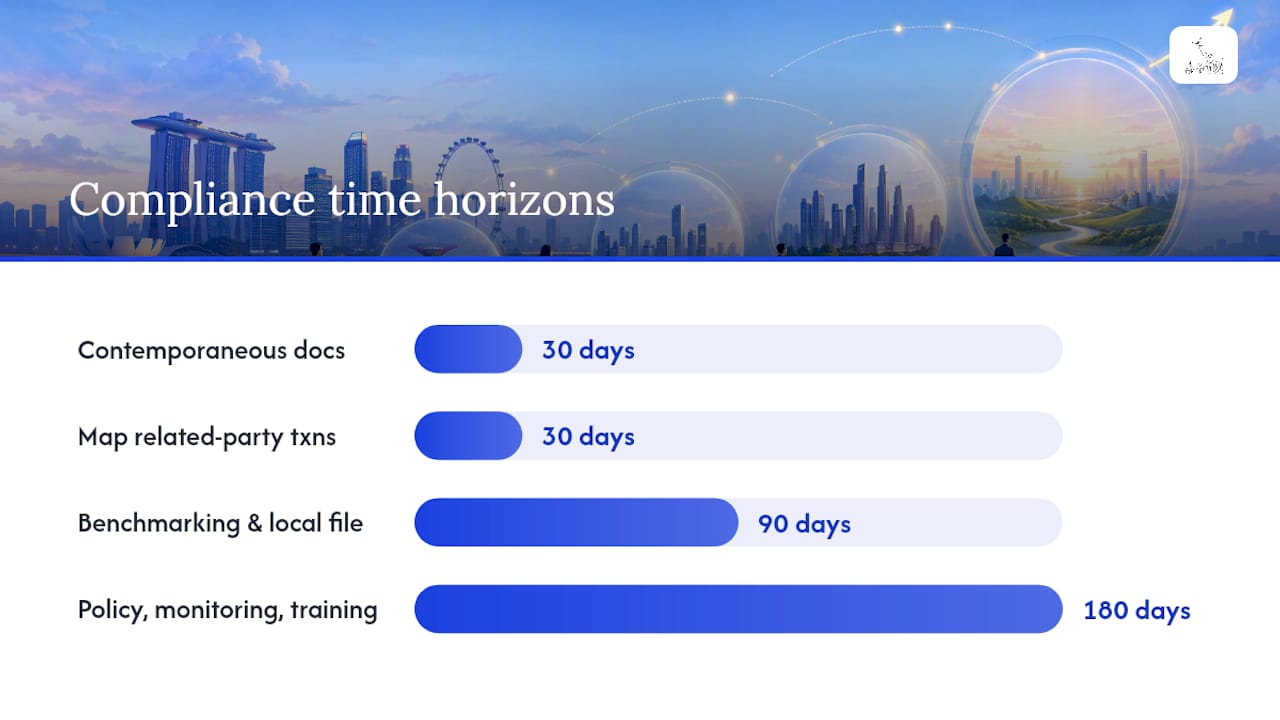
Your 30/90/180-day compliance checklist for SMEs
Prepare contemporaneous documentation and remediate any unsupported related-party pricing within 30 days. That is the single most effective action an SME can take to reduce transfer pricing audit risk in Singapore.
Next 30 days:
Map all related-party transactions for the current financial year (goods, services, loans, royalties, cost sharing).
Identify which transactions are covered by statutory exemptions and which require documentation.
For transactions requiring documentation, assess whether existing records are sufficient or need supplementing.
Check that intercompany agreements are in place, signed, and consistent with actual transaction terms.
Flag any transactions where pricing appears inconsistent with arm’s length conditions and quantify the gap.
Next 90 days:
Commission or update benchmarking studies for transactions that require them.
Prepare or finalize the local file for the current financial year.
Remediate any pricing that does not meet the arm’s length standard, with documented rationale.
Confirm that the master file (if required) reflects current group structure and policies.
Review CbCR obligations if your group meets the qualifying conditions.
Next 180 days:
Adopt a formal transfer pricing policy document that governs intercompany pricing going forward.
Set up a monitoring process to flag new related-party transactions before they are executed.
Assess whether any recurring high-value or complex transactions warrant an APA application.
Train finance and accounting staff on documentation requirements and the 30-day submission obligation.
Schedule an annual documentation review tied to the Form C filing calendar.
Pro Tip: Evidence of contemporaneity is often what decides an IRAS review. Date-stamp your working files, use version control on spreadsheets, and keep board minutes or email threads that show pricing decisions were made before transactions were executed, not after. A clean final report with no version history looks reconstructed, even when it is not.
Contemporaneous documentation is not just a compliance checkbox. It is the primary evidence that your pricing decisions were made in good faith, at the right time, and on the right basis. When IRAS reviews a file, the question is not only whether the numbers are defensible, but whether the process that produced them was genuine. Businesses that treat documentation as an annual cleanup exercise consistently face harder audits than those that build it into their transaction workflow.
When transactions involve unique intangibles, complex financing structures, or integrated supply chains across multiple jurisdictions, the documentation and method selection become significantly more technical. That is the point at which engaging a transfer pricing advisor, or applying for an APA, shifts from optional to genuinely risk-reducing. Headington’s team supports Singapore entities at exactly this stage, from documentation drafting through to APA applications.
Common pitfalls and what successful compliance looks like
The most frequent transfer pricing compliance failures in Singapore follow recognizable patterns.
Pitfall 1: Backdated documentation. A company prices intercompany services informally throughout the year, then prepares a transfer pricing study after receiving an IRAS inquiry. The study may reach the right conclusion, but the absence of contemporaneous evidence signals to IRAS that the pricing was not genuinely arm’s length at the time of the transaction. The 5% surcharge becomes a real risk even if the final numbers are defensible.

Pitfall 2: Group policy without local substance. A Singapore subsidiary relies entirely on a group transfer pricing policy prepared by overseas headquarters. The policy covers the group’s global transactions but lacks the entity-level detail required by the Second Schedule. When IRAS requests documentation, the Singapore entity cannot produce a compliant local file. The fix is straightforward: review the group documentation against the Second Schedule requirements and prepare a supplementary local file if gaps exist.
Pitfall 3: Misapplying the routine support services exemption. A company charges a 5% mark-up on costs for services that include elements of strategic advice or non-routine technical support. The exemption applies only to genuinely routine, low-value services. If IRAS reclassifies the services as non-routine, the exemption falls away and the company faces an adjustment on transactions it believed were exempt.
What successful compliance looks like: A mid-sized Singapore manufacturer with related-party purchases from its Malaysian parent maintains a local file updated annually before the Form C filing date. The file includes a functional analysis, a TNMM benchmarking study using Orbis data, and a clear explanation of why the tested party is the Singapore entity. Intercompany agreements are signed before transactions begin. When IRAS sends an inquiry, the company responds within two weeks with a complete, indexed package. The inquiry closes without an adjustment.
The difference between these two scenarios is almost entirely process, not technical complexity.
How do Singapore’s tax treaties interact with transfer pricing rules?
Singapore has an extensive network of tax treaties, and those treaties directly affect how transfer pricing disputes are resolved when they involve cross-border transactions. The interaction works on two levels.
At the prevention level, Singapore’s treaties generally include an Article 9 provision (based on the OECD Model Tax Convention) that authorizes each contracting state to make transfer pricing adjustments consistent with the arm’s length principle. This means that when IRAS makes an adjustment, the treaty framework is what allows the adjustment to be made without automatically constituting double taxation, provided the other jurisdiction makes a corresponding adjustment.
At the relief level, the MAP provision in Singapore’s treaties (typically Article 25 of the OECD Model) gives taxpayers the right to present their case to the Competent Authority when they believe taxation is not in accordance with the treaty. If IRAS increases the Singapore entity’s income and the overseas jurisdiction does not reduce the counterparty’s income by the same amount, the taxpayer faces genuine double taxation. MAP is the mechanism to resolve that. Singapore’s Competent Authority is IRAS, and MAP requests are filed directly with IRAS.
APAs can also be bilateral, negotiated between IRAS and a treaty partner’s tax authority. A bilateral APA eliminates the risk of conflicting adjustments by agreeing in advance on the pricing methodology for a defined set of transactions. For businesses with significant, recurring cross-border related-party transactions, a bilateral APA is often the most cost-effective long-term solution, even accounting for the time and cost of the application process.
One practical note: not all of Singapore’s treaties include a mandatory arbitration clause. Where arbitration is not available and MAP negotiations stall, the taxpayer’s options narrow. Identifying this risk before a dispute arises, rather than after, is part of sound transfer pricing planning.
Timing and deadlines for transfer pricing documentation
The core deadline is the filing due date of the Income Tax Return (Form C) for the financial year in which the transactions took place. Documentation prepared by that date qualifies as contemporaneous under IRAS rules. Documentation prepared after that date does not, regardless of how thorough it is.
For most Singapore companies, Form C is due by November 30 of the year following the financial year end. A company with a December 31 financial year end has until November 30 of the following year to finalize its transfer pricing documentation. A company with a March 31 year end has until November 30 of the same calendar year.
Beyond the Form C deadline, the 30-day submission window applies whenever IRAS requests documentation. This is a hard operational deadline: if IRAS sends a documentation request and you cannot produce a compliant file within 30 days, you are exposed to penalties and the inference that documentation was not maintained.
Retention obligations run for at least five years from the end of the financial year to which the documentation relates. This covers the period during which IRAS can raise assessments and conduct audits.
For CbCR filers, the filing deadline is 12 months after the end of the MNE group’s financial year. Notification obligations (where a Singapore entity is not the ultimate parent but the group is required to file CbCR) have their own deadlines, which align with the financial year end.
How to prepare for and respond to an IRAS transfer pricing audit
Preparation before an audit notice arrives is what determines how smoothly the process goes. The companies that handle IRAS transfer pricing audits with minimal disruption share one characteristic: they treat documentation as a live, maintained record rather than an annual project.
Before any audit notice:
Maintain a documentation index that maps each related-party transaction to its supporting file, agreement, and benchmarking evidence.
Conduct an annual self-assessment against the arm’s length standard before the Form C filing date.
Ensure intercompany agreements are current, signed, and consistent with actual transaction terms and volumes.
Keep a record of how pricing decisions were made, including the date, the decision-maker, and the basis.
When an audit notice or information request arrives:
Read the request carefully and identify exactly what IRAS is asking for. Requests are often more specific than they appear.
Assign a single point of contact within your organization to manage the response.
Pull the documentation index and identify what is immediately available versus what needs to be compiled.
If documentation gaps exist, do not reconstruct records retroactively. Disclose the gap and explain the pricing basis from available evidence.
Submit within the 30-day window. If you need more time, request an extension early, not on day 29.
If the inquiry escalates to a proposed adjustment, engage a transfer pricing advisor before responding.
One thing that consistently surprises companies during audits: IRAS pays close attention to whether the economic substance of the transaction matches its legal form. An intercompany service agreement that says one thing but is contradicted by emails, invoices, and actual behavior will not survive scrutiny, regardless of how well the transfer pricing study is written.
What experienced advisors know about Singapore transfer pricing that most guides miss
The conventional wisdom in transfer pricing compliance is that documentation is primarily a defensive tool: prepare it, file it, and hope IRAS never asks for it. That framing misses the more important function.
Contemporaneous documentation, prepared properly and maintained as a live record, is the clearest signal to IRAS that your pricing decisions were made in good faith and on a sound basis. Companies that build documentation into their transaction workflow, rather than treating it as a year-end cleanup, consistently face shorter, less disruptive IRAS inquiries. The documentation does not just defend the price; it demonstrates the process.
The other thing most guides understate is the gap between group-level documentation and Singapore compliance. A multinational group’s master file, prepared by headquarters for global purposes, rarely contains the entity-level detail the Second Schedule requires for the Singapore local file. Singapore entities that rely on group documentation without reviewing it against local requirements are exposed, often without knowing it. The fix is not complicated, but it requires someone to actually read the Second Schedule and compare it against what the group file contains.
For SMEs with straightforward related-party transactions, the compliance burden is manageable. For businesses with intangibles, financing structures, or integrated supply chains, the technical complexity rises quickly. The 5% surcharge on adjustments concentrates the mind: getting the pricing right, and documenting it properly, is almost always cheaper than defending an adjustment after the fact.
Headington can help you get Singapore transfer pricing right
Transfer pricing compliance in Singapore requires more than a spreadsheet. It requires a clear understanding of which transactions need documentation, which simplifications apply, and how to structure a defensible benchmarking study before IRAS asks for one.
Headington brings 25+ years of cross-border advisory experience and in-house experts covering 90 countries to Singapore transfer pricing engagements. The team handles the full compliance cycle: transfer pricing risk assessments, master and local file preparation, benchmarking studies using accepted databases, CbCR advisory, APA applications, and audit response support. For businesses expanding into or out of Singapore, Headington also integrates transfer pricing planning with entity structuring and tax treaty analysis, so your intercompany pricing is defensible from day one.
To book a transfer pricing risk assessment or discuss your documentation obligations, contact Headington directly. The earlier you engage, the more options you have.
Sources
The primary sources for Singapore transfer pricing rules are the IRAS guidance pages, the Income Tax Act, the 2018 Documentation Rules, and the OECD country profile. These are the documents to read before making any compliance decision.
Comments