
Preference Shares vs Ordinary Shares: 2026 Investor Guide


Preference shares are defined as a class of stock that grants holders fixed dividend payments and priority claims on assets over ordinary shareholders. Ordinary shares, by contrast, confer voting rights and unlimited capital growth potential but rank last in dividend payments and liquidation. The core tradeoff in the preference shares vs ordinary shares decision is income stability and downside protection against governance control and growth upside. Understanding this distinction shapes how investors build portfolios and how business owners structure capital raises.
What are the key differences between preference shares and ordinary shares?
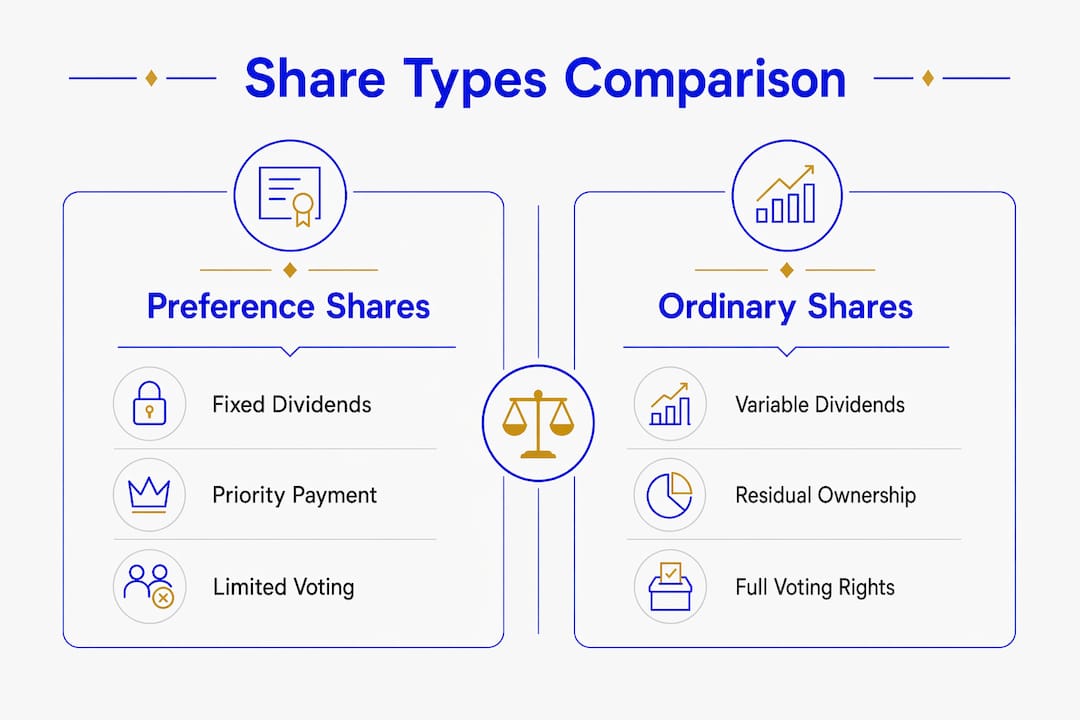
The fundamental difference between preference and ordinary shares lies in three areas: dividend structure, voting rights, and liquidation priority. Each area carries direct financial consequences for investors and founders alike.
Ordinary shares provide residual ownership with voting rights and unlimited upside but rank last for dividends and in liquidation. That subordinate position means ordinary shareholders absorb the most risk in any distressed scenario. Preference shares, on the other hand, pay fixed dividends with priority over ordinary shares. A 6% dividend on a $25 par value share, for example, yields $1.50 annually regardless of company performance.

Preference shares act as hybrid securities sitting between debt and equity. Their fixed dividend nature makes their market prices inversely sensitive to interest rate movements, unlike ordinary shares, which respond primarily to earnings growth. This interest rate sensitivity is a risk many investors overlook when first investing in preference shares.
Feature | Preference shares | Ordinary shares |
Dividend type | Fixed, priority payment | Variable, residual payment |
Voting rights | Limited or none | Full, typically one vote per share |
Liquidation priority | Senior claim on assets | Last claim after all creditors |
Growth potential | Capped by fixed terms | Unlimited |
Interest rate sensitivity | High | Low to moderate |
Pro Tip: Cumulative preference shares accrue any missed dividends as arrearages, which must be paid in full before ordinary shareholders receive anything. Non-cumulative preference shares do not carry this protection. If a company skips a dividend on non-cumulative shares, that income is gone permanently. Always confirm which type you hold before assessing income risk.
How do the advantages and disadvantages of each share type compare?
Investors choose between share types based on their risk tolerance, income needs, and desire for governance influence. Neither type is universally superior. Each serves a distinct investor profile.
Advantages of preference shares
Fixed income stability. Preference shares deliver predictable dividend payments, making them attractive to income-focused investors such as retirees or institutional funds with liability-matching mandates.
Priority in liquidation. Liquidation preferences allow investors to recoup capital before ordinary shareholders receive any residual value in a sale or insolvency event.
Lower volatility. Because returns are fixed rather than tied to earnings growth, preference shares typically experience smaller price swings than ordinary shares.
Downside protection. Preference shares serve as financial risk management tools, trading growth potential for income stability and priority claims.
Disadvantages of preference shares
Limited or no voting rights. Preference shareholders typically hold no vote in ordinary times, surrendering governance influence entirely.
Capped upside. Fixed dividends mean preference holders do not benefit from exceptional company performance the way ordinary shareholders do.
Interest rate exposure. Rising interest rates reduce the market value of preference shares, since their fixed payouts become less attractive relative to new fixed-income instruments.
Dividends are not guaranteed. Preference dividends depend on company solvency and board declaration. A company under financial stress may legally suspend payments.
Advantages of ordinary shares
Voting control. Ordinary shares carry one vote per share, empowering holders to elect boards, approve major transactions, and influence company direction.
Unlimited appreciation potential. Ordinary shareholders capture the full benefit of company growth, with no ceiling on capital gains.
Alignment with company success. Variable dividends can grow substantially as earnings increase, rewarding long-term holders.
Disadvantages of ordinary shares
Last claim in liquidation. Ordinary shareholders receive residual value only after creditors, bondholders, and preference shareholders are paid in full.
Variable income. Dividends are never guaranteed and can be cut or suspended without triggering the same protections cumulative preference shares provide.
What legal and structural factors matter when issuing or investing in these shares?
The legal architecture around share classes determines real-world outcomes far more than the headline terms suggest. Investors and founders who read only the dividend rate miss the provisions that actually govern exit proceeds and control.
Liquidation preferences are the most consequential clause in any preference share agreement. A 1x non-participating liquidation preference means investors get their money back first, then ordinary shareholders split the remainder. A participating preference, however, lets investors take their liquidation amount and then share in the residual alongside ordinary shareholders. That distinction can dramatically reduce founder and employee payouts in a moderate exit.
Conversion rights trigger automatic conversion of preference shares to ordinary shares during liquidity events such as IPOs. Founders often underestimate the impact of these triggers. Conversion can dilute existing ordinary shareholders and strip preference holders of their protective rights simultaneously, creating outcomes neither party anticipated.
Voting rights in preference shares are more nuanced than a simple yes or no. Preference shareholders may gain temporary voting rights after a company misses dividend payments. Protective provisions, which are veto rights over specific corporate actions, are common in venture-backed structures and can block fundraising rounds, acquisitions, or changes to share class terms.
Review the liquidation waterfall. Model at least three exit scenarios: a distressed sale at cost, a moderate return at 2x invested capital, and a strong exit at 5x. Each scenario produces different outcomes depending on preference terms.
Clarify conversion triggers. Confirm exactly which events trigger automatic conversion and whether holders retain the right to convert voluntarily before those events.
Audit protective provisions. List every veto right attached to preference shares before closing a round. Provisions that seem minor at seed stage can block strategic decisions at Series B.
Check cumulative vs. non-cumulative status. Cumulative shares accumulate unpaid dividends as arrearages. Non-cumulative shares do not. This single distinction changes the income risk profile materially.
Get independent legal counsel. Shareholder agreements governing preference shares are not standard documents. Terms vary significantly across jurisdictions and deal structures.
Pro Tip: Founders should model exit scenarios using actual preference share terms before signing any term sheet. A $10 million exit with a 2x participating preference on $3 million invested can leave ordinary shareholders with far less than a headline number suggests.
When should investors or business owners choose preference shares versus ordinary shares?
The right share type depends on the investor’s objective and the company’s stage. There is no single correct answer, but clear patterns emerge across deal types.
Choose preference shares when downside protection matters most. Early-stage investors face high failure rates. Preference shares with liquidation preferences and cumulative dividends reduce capital loss in adverse outcomes. Venture capital funds and angel investors routinely use preference shares for this reason.
Choose preference shares for income-focused portfolios. Investors who need predictable cash flow, such as pension funds or income-oriented retail investors, benefit from fixed dividend payments that ordinary shares cannot guarantee.
Choose ordinary shares when control is the priority. Founders, co-founders, and strategic partners who need to direct company decisions should hold ordinary shares. Voting rights are the primary tool for governance, and preference shares rarely carry them.
Choose ordinary shares for long-term growth exposure. Investors with a long time horizon and high risk tolerance capture more value through ordinary shares when a company performs well. The unlimited upside of ordinary shares outperforms fixed preference dividends in high-growth scenarios.
Consider a mixed structure for balance. Many sophisticated investors hold both types across a portfolio. Preference shares in early-stage companies provide downside protection, while ordinary shares in established businesses capture growth. This combination manages risk without sacrificing all upside.
Investors choose preference shares for downside protection and income stability, while ordinary shares appeal for growth and control. The practical implication is that the two share types are not competing products but complementary instruments serving different roles in a well-structured portfolio or capital table.
Key Takeaways
Preference shares and ordinary shares serve fundamentally different investor needs, and the right choice depends on whether you prioritize income stability and downside protection or governance control and growth potential.
Point | Details |
Dividend structure differs | Preference shares pay fixed dividends first; ordinary shares pay variable dividends last. |
Voting rights are exclusive to ordinary shares | Ordinary shareholders control governance; preference holders typically have no vote. |
Liquidation priority protects preference holders | Preference shareholders recover capital before ordinary shareholders in any exit or insolvency. |
Cumulative status changes income risk | Cumulative preference shares accrue missed dividends; non-cumulative shares lose them permanently. |
Legal terms determine real outcomes | Liquidation preferences, conversion rights, and protective provisions shape actual returns more than headline dividend rates. |
What I’ve learned from watching founders misread their own cap tables
After years of advising investors and business owners on capital structure, the most consistent mistake I see is treating preference shares as a simple “safer” alternative to ordinary shares. That framing is incomplete and sometimes dangerous.
The real risk in preference shares is not the fixed dividend. It is the legal architecture underneath it. I have watched founders sign term sheets with participating liquidation preferences without modeling a single exit scenario. When a moderate acquisition offer arrived, the preference stack consumed most of the proceeds, leaving ordinary shareholders, including the founding team, with a fraction of what they expected.
Ordinary shares carry their own blind spots. Investors who hold only ordinary shares in early-stage companies often discover their position is worth nothing in a down-round exit, because preference holders absorb all available proceeds first. The unlimited upside of ordinary shares is real, but so is the unlimited downside.
My practical advice: before you issue or accept either share type, run the numbers on three exit scenarios and read every clause in the shareholder agreement. The difference between a 1x non-participating preference and a 2x participating preference is not a legal technicality. It is the difference between a fair outcome and a deeply unfair one. Legal counsel who specializes in corporate finance is not optional at this stage. It is the most cost-effective investment you can make before signing.
— Colin
How Headington supports your share structure decisions
Structuring share classes correctly at the outset protects both investors and founders from costly disputes and unexpected outcomes at exit. Headington brings 25+ years of corporate and legal advisory experience across 90 countries to help investors and business owners design capital structures that reflect their actual goals.

Whether you are raising capital with preference shares, issuing ordinary shares to a founding team, or reviewing an existing shareholder agreement, Headington’s in-house experts provide jurisdiction-specific guidance tailored to your deal. From liquidation waterfall modeling to conversion rights analysis, the team covers the full scope of share class structuring. Visit Headington’s advisory services to discuss your capital structure with an experienced advisor.
FAQ
What is the main difference between preference and ordinary shares?
Preference shares pay fixed dividends with priority over ordinary shares and rank ahead in liquidation, while ordinary shares carry voting rights and unlimited growth potential but rank last in both dividends and asset claims.
Are preference share dividends guaranteed?
Preference dividends are not guaranteed. They depend on company solvency and board declaration, though cumulative preference shares accrue any missed payments as arrearages until paid in full.
Do preference shareholders get to vote?
Preference shareholders typically hold limited or no voting rights in ordinary times. Some agreements grant temporary voting rights after a company misses dividend payments, but this varies by share class terms.
What is a liquidation preference in preference shares?
A liquidation preference gives preference shareholders the right to recover their invested capital before ordinary shareholders receive any proceeds in a sale, merger, or insolvency event.
When should a business owner issue preference shares instead of ordinary shares?
Business owners typically issue preference shares to outside investors seeking downside protection and income stability, while reserving ordinary shares for founders and employees who need voting control and growth participation.

Comments