
Outsourced Accounting Services Cost: 2026 Guide for Singapore


Outsourced accounting services cost is defined as the total monthly or annual fee a business pays a third party to handle its financial recordkeeping, reporting, and advisory functions. For Singapore business owners, that figure typically falls between $500 and $15,000 per month, depending on service tier and business complexity. A widely used budgeting benchmark places finance function spending at 1–4% of annual revenue. Understanding where your business sits within that range is the first step toward making a confident outsourcing decision.
What are the typical pricing tiers for outsourced accounting?
Outsourced accounting pricing follows a three-tier structure, and each tier reflects a distinct level of financial support. Choosing the wrong tier is one of the most common and costly mistakes business owners make.
Tier 1: Basic bookkeeping ($500–$1,500/month)
Tier 1 covers transaction recording, bank reconciliation, and monthly financial statements. This tier suits early-stage companies with low transaction volumes and straightforward financials. You get clean books, but no strategic input.
Services typically included:
Bank and credit card reconciliation
Accounts payable and receivable data entry
Monthly profit and loss statement
Basic expense categorization
Tier 2: Full accounting ($1,500–$5,000/month)
Tier 2 adds payroll coordination, accounts payable and receivable management, and more detailed financial reporting. This level fits growing companies that need accurate cash flow visibility but are not yet ready for a full-time finance hire. Transaction volume and entity count are the main drivers that push a business from Tier 1 into Tier 2.

Tier 3: Controller and fractional CFO services ($5,000–$15,000/month)
Tier 3 delivers strategic finance functions including financial planning and analysis, board reporting, and CFO advisory. This tier suits companies preparing for fundraising, acquisition, or rapid expansion. The cost reflects the seniority of the professionals involved, not just the volume of work.
Services typically included:
Financial modeling and forecasting
Board and investor reporting
Budgeting and variance analysis
Compliance oversight and audit preparation
Strategic cash flow management
Pro Tip: Before selecting a tier, map your monthly transaction count and list every finance task your team currently handles manually. That exercise alone will tell you which tier fits, and it prevents you from paying for services you do not need.
The tier that fits your business today may not fit it in 12 months. Build in a review clause with your provider so you can scale up or down without penalty.
How do pricing models influence outsourcing accounting fees?
The pricing model your provider uses shapes your monthly budget as much as the service tier does. Four main models dominate the outsourced accounting market.
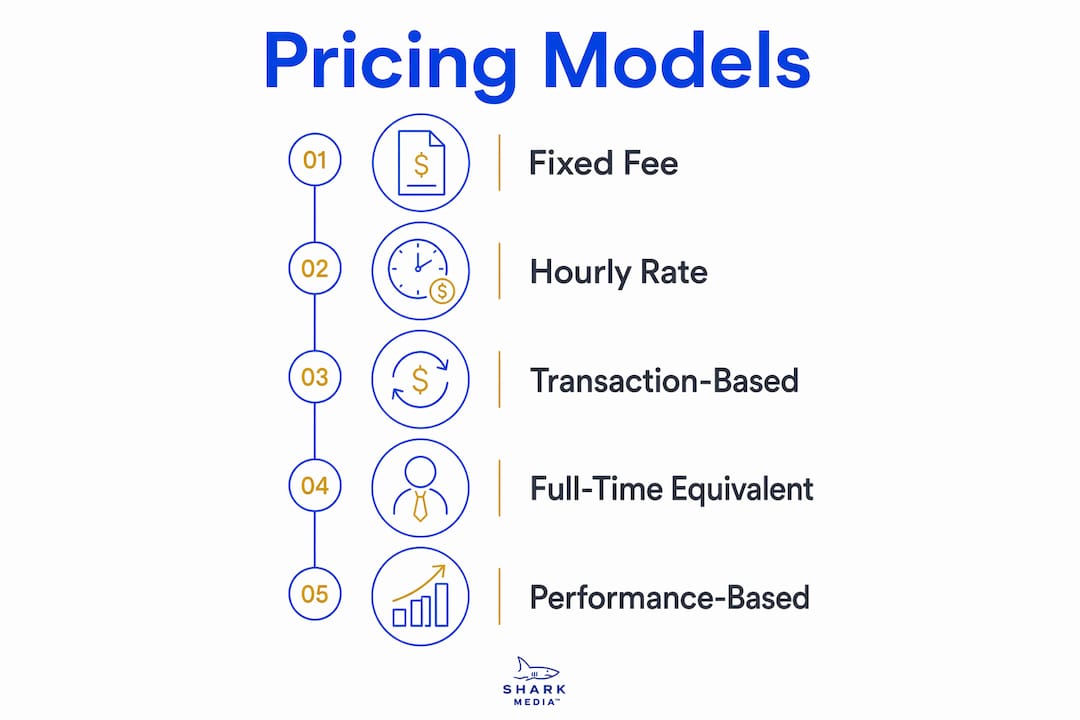
Fixed monthly fee. You pay a set amount regardless of how much work the provider does that month. This model makes budgeting predictable and works well for businesses with stable, consistent transaction volumes. The risk is that you may overpay during slow months.
Hourly rate. You pay only for time used. Hourly rates give you flexibility but make monthly costs hard to forecast. This model suits project-based needs or businesses with highly variable workloads.
Transaction-based pricing. Fees adjust based on the number of invoices, receipts, or journal entries processed. This model ties cost directly to workload, which sounds fair. The problem is that a sudden spike in transactions can push your bill well above your planned budget.
Full-Time Equivalent (FTE) model. You pay for a dedicated accounting resource, typically priced as a fraction of a full-time salary. The FTE model gives you consistent output and a named point of contact. It suits businesses that need ongoing, high-volume support without the overhead of a direct hire.
Performance-based pricing. This model applies mainly to fractional CFO engagements, where fees are partly tied to financial outcomes achieved. Performance-based pricing suits advisory work but complicates budgeting because payment depends on results that are not always within the provider’s direct control.
Pro Tip: Ask every provider to show you a sample invoice from a client with a similar transaction volume. That single document reveals how the pricing model behaves in practice, not just in theory.
The right model depends on your cash flow pattern. Businesses with predictable revenue favor fixed fees. Businesses with seasonal peaks often benefit from transaction-based or hourly arrangements.
How does outsourcing cost compare to hiring in-house?
The cost difference between outsourcing and in-house hiring is significant. A staff accountant in Singapore costs $85,000–$130,000 annually on a fully loaded basis, including salary, CPF contributions, benefits, office space, and software licenses. Outsourcing the same functions reduces that cost by 40–75% depending on the model and provider location.
Offshore dedicated accountants represent the most aggressive cost reduction. One documented example shows a company paying $6,000 per month for domestic accounting services that reduced to $1,500 per month using an offshore model with equivalent scope and quality. That is a 75% reduction with no loss of function.
“The true cost of an in-house accountant is rarely just the salary. Add CPF, annual leave, medical benefits, recruitment fees, training, and the cost of covering absences, and the real number is often 30–40% above the base salary figure. Outsourcing bundles all of that into one predictable monthly fee.”
The comparison is not purely financial. In-house staff offer direct control, institutional knowledge, and faster response to ad hoc requests. Outsourced providers offer breadth of expertise, built-in redundancy, and no recruitment risk. For most Singapore SMBs, the financial case for outsourcing is clear. The strategic case depends on how much direct control you need over your finance function.
For a detailed breakdown of what outsourced bookkeeping covers versus a full in-house team, the distinction matters when you are scoping a provider contract.
What hidden costs should you watch for in outsourced accounting?
The headline monthly fee is rarely the full picture. Setup fees are the most commonly overlooked cost. Onboarding and system migration typically costs $1,500–$5,000 as a one-time charge. This covers data migration, accounting system configuration, and process documentation. Skipping a thorough onboarding is the fastest way to create problems that cost more to fix later.
Watch for these specific cost triggers:
Transaction volume overages. Providers may quote a base rate that assumes a fixed transaction count. Exceed that count and your fee can jump sharply. A $1,500 per month quote can rise to $3,500 per month once volume thresholds are breached.
Tax preparation exclusions. Most outsourced accounting packages do not include corporate tax filing. Expect a separate annual fee for GST returns, corporate income tax, and transfer pricing documentation if applicable.
Software subscription costs. Some providers pass through the cost of accounting software licenses, such as Xero or QuickBooks, as a separate line item. Others bundle it. Confirm this before signing.
Scope creep charges. Ad hoc requests outside the agreed scope, such as investor reporting or due diligence support, are typically billed at hourly rates. Define your scope clearly in the contract.
Pro Tip: Request a written scope of services document before signing any agreement. Ask the provider to list at least five tasks that fall outside the standard package. That list tells you exactly where surprise charges will come from.
The service inclusions comparison matters more than the headline price. Two providers quoting $2,000 per month may deliver very different scopes. Always compare what is included, not just what is charged.
How should Singapore business owners choose the right service model?
Choosing the right outsourcing model requires matching your operational reality to the right tier and pricing structure. Start with these four criteria:
Revenue and transaction volume. A company processing fewer than 200 transactions per month rarely needs more than Tier 1 or Tier 2. Higher volumes demand more structured support and a pricing model that accounts for workload variability.
Operational versus strategic needs. If you need clean books and payroll run on time, Tier 1 or Tier 2 delivers that. If you need cash flow forecasting, scenario modeling, or board reporting, Tier 3 is the right level. Misallocating spend by choosing the wrong tier leads to either overpaying or getting insufficient support.
Compliance requirements. Singapore companies must comply with ACRA filing requirements, IRAS tax obligations, and, where applicable, GST registration rules. Confirm that your provider has direct experience with Singapore-specific compliance, not just generic accounting knowledge.
Growth trajectory. A business expecting to double revenue in 18 months needs a provider that can scale with it. Ask specifically how the provider handles tier upgrades and whether contracts allow for scope changes without penalty.
Provider model. The choice between a CPA firm, a freelance accountant, and an offshore dedicated team affects cost, control, and expertise. Each model carries different trade-offs in terms of responsiveness, depth of knowledge, and scalability. For Singapore businesses with cross-border operations, a provider with multi-jurisdiction experience adds measurable value.
For businesses evaluating outsourced bookkeeping services as a starting point, comparing service scope across providers before committing to a pricing model is the most practical first step.
Key Takeaways
Outsourced accounting costs range from $500 to $15,000 per month, and the right tier, pricing model, and provider type determine whether you save money or simply shift costs around.
Point | Details |
Pricing tiers define scope | Tier 1 covers bookkeeping; Tier 3 includes CFO advisory and financial planning. |
In-house costs are higher | Outsourcing reduces accounting costs by 40–75% compared to a fully loaded in-house hire. |
Hidden costs are real | Setup fees of $1,500–$5,000 and transaction overages can significantly raise your actual monthly spend. |
Pricing model affects predictability | Fixed fees suit stable businesses; transaction-based models suit variable workloads. |
Tier selection drives ROI | Choosing the wrong tier leads to overpaying or receiving insufficient financial support. |
What I’ve learned about outsourced accounting spend after 25 years
The most common mistake I see Singapore business owners make is treating outsourced accounting as a cost-cutting exercise rather than a financial infrastructure decision. They chase the lowest monthly fee, skip the onboarding process, and then spend twice as much fixing the mess six months later.
The headline price tells you almost nothing. What matters is what the provider actually delivers for that fee, how quickly they respond when something goes wrong, and whether they understand Singapore’s specific compliance environment. A provider quoting $800 per month who excludes GST filing, tax preparation, and payroll coordination is not cheaper than one quoting $1,500 per month who includes all three.
My advice: review your service agreement every 12 months. Your business changes. Your accounting needs change with it. The tier that fit you at $2 million in revenue will not fit you at $8 million. Providers rarely volunteer to upgrade your service level. You have to ask.
— Colin
Headington’s outsourced accounting solutions for Singapore businesses
Headington works with Singapore business owners and financial decision-makers who need outsourced accounting support that matches their actual complexity, not a generic package.
With 25+ years of experience and in-house experts covering 90 countries, Headington provides accounting and corporate advisory services across multiple service tiers, from foundational bookkeeping to fractional CFO support. Pricing is structured to reflect your transaction volume, entity complexity, and compliance requirements, so you pay for what you need and nothing more. If you are evaluating your options or ready to move forward, contact Headington for a consultation tailored to your business.
FAQ
What is the average cost of outsourced accounting services?
Outsourced accounting services cost between $500 and $15,000 per month depending on service tier, transaction volume, and business complexity. Most growing SMBs fall in the $1,500–$5,000 per month range.
Is outsourcing accounting cheaper than hiring in-house?
Outsourcing reduces accounting costs by 40–75% compared to a fully loaded in-house hire, which typically costs $85,000–$130,000 annually in salary, benefits, and overhead.
What hidden fees should I watch for in outsourced accounting contracts?
Setup fees of $1,500–$5,000, transaction volume overages, and excluded services like tax preparation are the most common sources of unexpected charges. Always request a written scope of services before signing.
What pricing model is best for a Singapore SMB?
Fixed monthly fees work best for businesses with stable, predictable transaction volumes. Transaction-based pricing suits companies with seasonal or variable workloads.
Does outsourced accounting cover Singapore tax and ACRA compliance?
Not always. Many providers exclude GST filing, corporate income tax preparation, and ACRA annual return filing from their standard packages. Confirm exactly which compliance tasks are included before committing to a contract.
Comments