
Legal Advice for Businesses in Singapore: 2026 Guide


Legal advice for businesses is the foundation that supports compliance, contract integrity, and sustainable growth from day one. In Singapore, startups and SMEs operate under a precise regulatory framework governed by the Accounting and Corporate Regulatory Authority (ACRA), the Inland Revenue Authority of Singapore (IRAS), and the Personal Data Protection Commission (PDPC). Missing a filing deadline or signing a poorly worded contract can freeze your bank account, trigger penalties, or expose directors to personal liability. The right legal counsel turns those risks into managed variables, not surprises.
What legal advice do Singapore startups and SMEs need for compliance?
Compliance in Singapore is not optional, and the obligations start immediately after incorporation. ACRA requires companies to appoint a qualified company secretary within six months of incorporation. That secretary must be a local resident and meet specific qualification standards. Miss that window, and you are already non-compliant before your first invoice.
The annual compliance calendar is dense. Singapore companies must file Estimated Chargeable Income with IRAS, hold an Annual General Meeting, submit an Annual Return to ACRA, and file corporate tax returns, all by strict deadlines. Each obligation carries its own penalty structure for late or incorrect submissions. A legal advisor for business keeps that calendar visible and actionable.
The regulatory framework also includes the Companies Act, the Employment Act, and the Personal Data Protection Act (PDPA). If your business collects customer data, the PDPC requires a documented data protection policy and a designated Data Protection Officer. GST registration becomes mandatory once your taxable turnover crosses the threshold set by IRAS. Each of these triggers a legal obligation that most founders discover too late.
Business owners often confuse the role of a company secretary with that of corporate counsel. A company secretary handles statutory filings and maintains registers. Corporate counsel provides strategic legal advice, reviews contracts, and manages risk. Both roles are necessary. Treating them as interchangeable is one of the most common and costly mistakes early-stage companies make.
Company secretary: Handles ACRA filings, AGM notices, and statutory registers
Corporate counsel: Drafts and reviews contracts, advises on regulatory exposure, and supports fundraising
PDPA compliance officer: Manages data governance policies and breach response protocols
Tax advisor: Works alongside IRAS filings to optimize GST and corporate tax positions
Pro Tip: Set calendar reminders for every ACRA and IRAS deadline at the start of each financial year. A missed Estimated Chargeable Income filing triggers an automatic penalty, even if your actual tax liability is zero.
How does legal advice help with contracts and risk management?
Contracts are where most business disputes originate. A poorly drafted shareholder agreement, a vague vendor contract, or an employment offer letter missing key clauses can cost more to litigate than the original deal was worth. Template contracts from the internet often lack jurisdictional specificity, and limitation of liability clauses need precise wording to be enforceable under Singapore law.

Singapore contract law draws from the Contracts Act and a body of local case law that differs meaningfully from UK or US precedents. A clause that protects you in one jurisdiction may be unenforceable here. This is not a theoretical risk. Founders who use generic online templates for shareholder agreements regularly discover gaps when a co-founder dispute arises or an investor requests due diligence.
The most common contracts that need professional review include:
Shareholder agreements: Define voting rights, exit mechanisms, and dispute resolution procedures
Vendor and client contracts: Specify deliverables, payment terms, and liability caps
Employment offer letters and service agreements: Must align with the Employment Act on notice periods, leave entitlements, and termination conditions
Non-disclosure agreements: Require jurisdiction-specific enforceability clauses to hold up in Singapore courts
Technology and IP licensing agreements: Define ownership of work product, especially critical for software companies
Contract type | Common risk without legal review | What proper drafting prevents |
Shareholder agreement | Deadlock on major decisions | Defined voting thresholds and exit rights |
Vendor contract | Unlimited liability exposure | Capped liability and force majeure clauses |
Employment offer | Non-compliant termination terms | Alignment with Employment Act requirements |
NDA | Unenforceable confidentiality terms | Jurisdiction-specific enforceability language |
A tax strategy checklist for growing businesses reinforces the same principle: legal and financial risk management work best when integrated from the start, not patched after a problem surfaces.
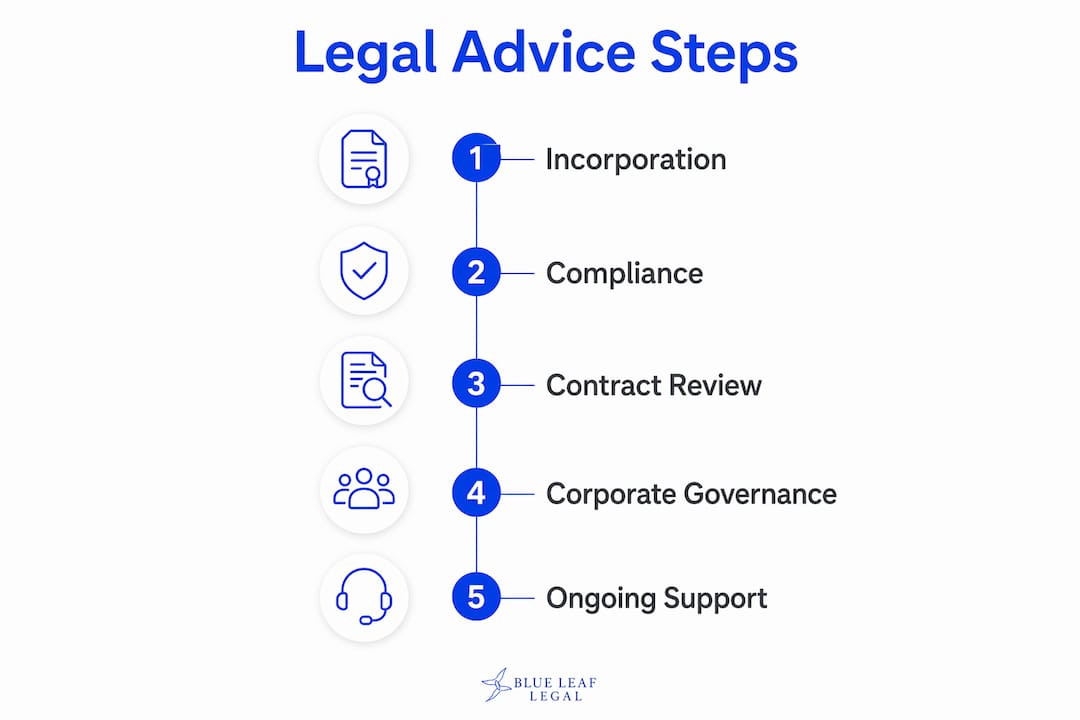
Pro Tip: Never sign a vendor contract above $10,000 SGD without a lawyer reviewing the liability and termination clauses. The review cost is a fraction of what a dispute will cost.
What role does corporate governance play in legal advice for startups?
Corporate governance is the internal system that keeps your company legally sound and investor-ready. Good governance signals operational maturity and directly affects your ability to raise funding, onboard institutional clients, and exit cleanly. Investors conduct due diligence on governance before they write a check. Gaps in board resolutions or missing statutory registers are red flags that delay or kill deals.
Directors in Singapore carry fiduciary duties under the Companies Act. Those duties include acting in the best interest of the company, avoiding conflicts of interest, and disclosing personal interests in transactions. At least one director must be a Singapore resident. Breaching these duties exposes directors to personal liability, not just corporate liability.
Proper governance documentation includes:
Board resolutions: Required for major decisions including opening bank accounts, entering significant contracts, and issuing shares
Statutory registers: Director and shareholder registers must be accurate and current at all times
Minutes of meetings: AGM and board meeting minutes must be maintained and available for inspection
Share certificates and cap table: Must reflect all equity transactions accurately to support fundraising rounds
Legal counsel supports governance by drafting resolutions, reviewing board decisions for legal exposure, and maintaining the documentation trail that regulators and investors expect. Non-compliance risks include frozen bank accounts, director disqualification, and in serious cases, forced insolvency. These are not edge cases. They happen to founders who treat governance as paperwork rather than protection.
Where can business owners in Singapore access legal advice affordably?
Affordable legal support exists, but you need to know where to look and what each option actually delivers. Free legal advice for businesses is available through law school clinics, pro bono networks, and legal aid organizations that assist small businesses with specific legal matters. These services work well for one-off questions but are not a substitute for ongoing counsel.
For startups and SMEs that need regular legal support, the practical options break down into three tiers:
Ad hoc consultations: Pay per engagement. Good for specific contracts or one-time compliance questions. Expensive if used frequently.
Retainer arrangements: A fixed monthly fee for defined services. Predictable cost, faster response times, and a lawyer who knows your business.
Outsourced corporate secretarial and legal services: Firms like Headington bundle compliance management, secretarial functions, and legal advisory into a single engagement. This model suits SMEs that need professional coverage without hiring in-house.
When selecting a legal advisor for small business needs, watch for these red flags: advisors who cannot name the specific Singapore regulations that apply to your industry, firms that offer only template documents without customization, and providers who do not proactively flag upcoming compliance deadlines.
Pro Tip: Ask any prospective legal advisor to walk you through your first-year compliance calendar before you sign an engagement letter. If they cannot do it off the top of their head, they are not the right fit for a Singapore startup.
Regulatory compliance standards for professional service firms, including those outlined in MLR 2017 compliance frameworks, reinforce that the firms advising you should themselves operate under documented compliance programs. That is a reasonable standard to apply when evaluating who you hire.
Key Takeaways
Legal advice for businesses in Singapore is a growth enabler, not just a cost. Startups that integrate legal counsel from incorporation avoid the compliance gaps, contract disputes, and governance failures that derail fundraising and operations.
Point | Details |
Compliance starts at incorporation | ACRA requires a qualified company secretary within six months of incorporation. |
Contracts need jurisdiction-specific review | Generic templates often fail under Singapore law, especially liability and NDA clauses. |
Governance documentation protects directors | Accurate board resolutions and registers reduce personal liability and support investor due diligence. |
Secretary and counsel are different roles | Company secretaries handle filings; corporate counsel manages risk and strategy. |
Affordable options exist | Retainer and outsourced models give SMEs predictable legal coverage without in-house hiring costs. |
Why I stopped thinking of legal advice as a line item
Most founders I talk to treat legal fees the way they treat insurance: a grudging expense that only feels justified after something goes wrong. That framing is exactly backwards. Having a lawyer involved in strategic decisions early produces better outcomes than bringing one in after a dispute starts. The cost difference is not marginal. It is often the difference between a clean fundraising round and a six-month delay while investors wait for you to fix governance gaps.
The mistake I see most often is founders who spend months negotiating a client contract, then hand it to a lawyer only after the other side has already signed. At that point, the lawyer can only tell you what you agreed to. The leverage is gone. Legal counsel integrated before you negotiate, not after, changes what you can ask for and what you can protect.
Singapore’s regulatory environment rewards founders who treat compliance as a system, not a checklist. Proactive legal partnerships, built from the first year, are what separate companies that scale cleanly from those that stall at the Series A because their cap table is a mess or their employment contracts do not comply with the Employment Act.
— Colin
How Headington supports Singapore startups with legal and secretarial services
Running a startup in Singapore means managing ACRA filings, IRAS deadlines, PDPA obligations, and contract reviews simultaneously. Most founders do not have the bandwidth to do all of that well while also building a product and closing customers.
Headington brings 25+ years of experience and in-house experts covering 90 countries to help Singapore SMEs stay compliant and legally protected. From corporate secretarial services and annual compliance management to contract review and cross-border legal advisory, Headington handles the legal infrastructure so you can focus on growth. Reach out to Headington to get a clear picture of your compliance obligations and a plan to meet them without disruption.
FAQ
What does legal advice for businesses cover in Singapore?
Legal advice for businesses covers compliance with ACRA and IRAS requirements, contract drafting and review, corporate governance, employment law, and data protection under the PDPA. It also includes strategic support for fundraising, acquisitions, and cross-border expansion.
Is a company secretary the same as a legal advisor?
No. A company secretary manages statutory filings and maintains registers under ACRA requirements. A legal advisor provides strategic counsel on contracts, risk, and regulatory compliance. Both roles are necessary and serve different functions.
Where can small business owners get free legal advice in Singapore?
Free legal advice for small businesses is available through law school clinics, pro bono legal networks, and legal aid organizations. These services suit one-off questions but do not replace ongoing corporate counsel for compliance and contract management.
What happens if a Singapore company misses a compliance deadline?
Missing ACRA or IRAS deadlines triggers financial penalties and can result in frozen bank accounts, director disqualification, or forced insolvency in serious cases. Proactive compliance management prevents these outcomes.
When should a startup engage a legal advisor?
A startup should engage a legal advisor at incorporation, not after a problem arises. Early legal involvement covers shareholder agreements, employment contracts, and compliance setup before these become sources of disputes or regulatory exposure.
Comments